
Bardo · The Oath
Chapter 4
Between Tides
At sixteen, Theo learns what public talent, family privilege, applause, and ordinary harbor work reveal about the person he is becoming.
At sixteen, Theo learned that applause could make a person stupid.
He learned this in front of four hundred people.
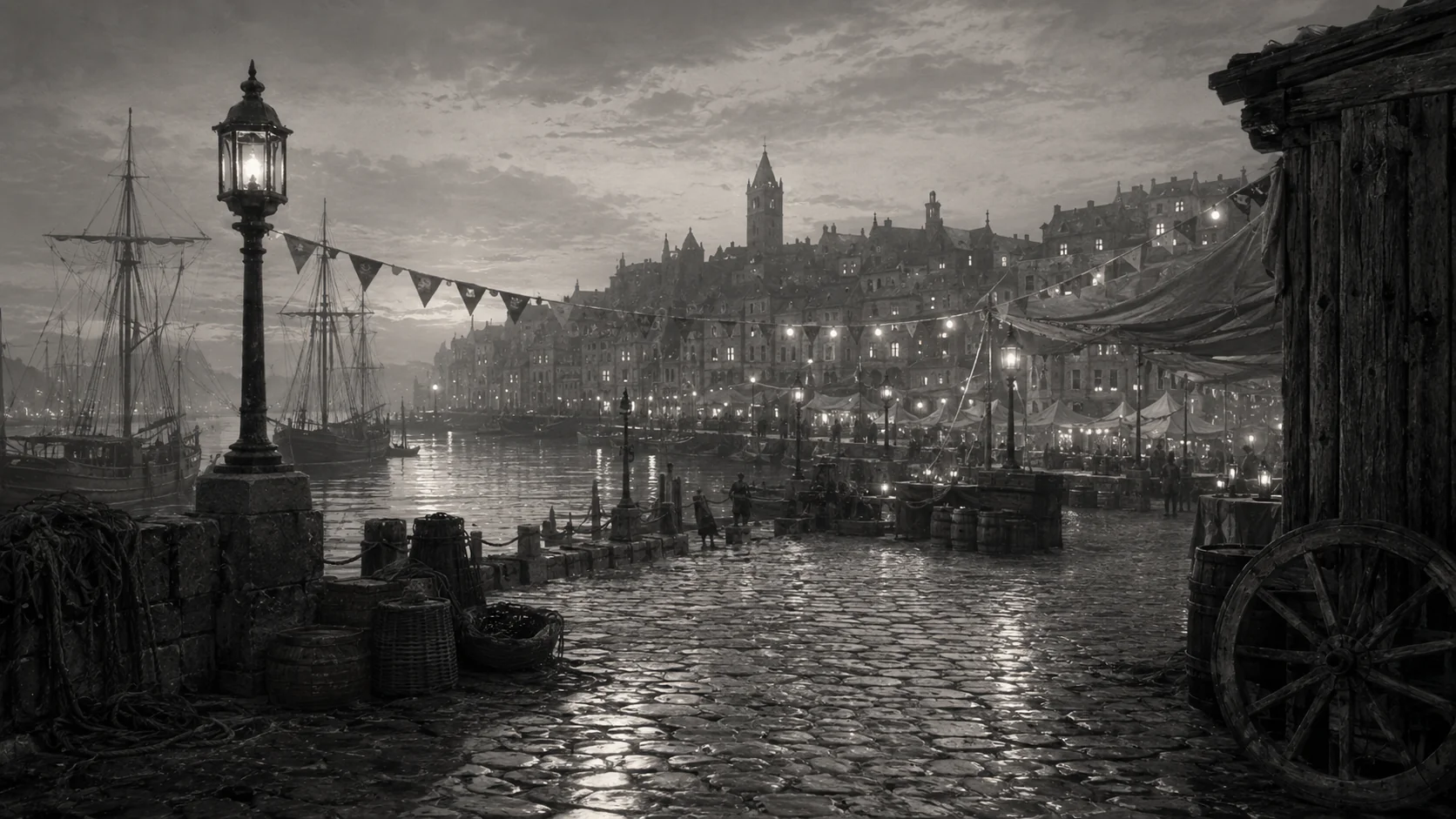
Founders’ Night filled Ternwick’s western market with lanterns, food stalls, merchant banners, and enough temporary dignity to make dockworkers wear clean shirts until supper. The city celebrated the renewal of its oldest harbor charters every seven years, though most people attended for the music, cheap cider, and legal permission to close three streets against carts.
Theo had been given the last solo before the civic speeches.
He had spent six weeks pretending this did not matter to him.
It mattered enormously.
Backstage, which was actually a sailmaker’s warehouse with curtains hung across the loading doors, he found his name printed on the performance slate.
THEODOROS AVELOS — LONG-NECKED LUTE
Theo stared at it.
Maud came up beside him carrying a tuning fork.
“Do not.”
“I haven’t done anything.”
“You are looking for chalk.”
“I am looking at an error.”
“The legal name supplied by your own household?”
“The public has done nothing to deserve all four syllables.”
Maud struck the tuning fork against her knee.
At fifty-two she had become grayer, not softer. Theo had grown nearly a foot since his first lesson and could now look down at her if he was willing to lose the argument immediately.
“The program was copied from the charter list,” she said.
“Then the charter list is hostile to art.”
“You are opening with the old south-coast courante. If you survive the first thirty-two measures, the audience may forgive your name.”
Theo took the pitch.
His lute had changed with him. The body no longer looked optimistic in his lap; it looked proportioned. His left hand reached every position comfortably. Callus covered the fingers that had once blistered through scales. The soundboard bore a small repaired dent from the year Tessa had knocked a music stand into it and then cried harder than Theo did.
He could play the courante without thinking about where his hands went.
That was the danger.
Maud knew it.
“What are you planning?” she asked.
“The written variation.”
“Which one?”
Theo smiled.
Maud closed her eyes briefly.
“Theo.”
He liked his name much better when she used it as a warning.
“I have a cleaner ending.”
“You have a faster ending.”
“They are not mutually exclusive.”
“They become so when you are pleased with yourself.”
Theo checked the upper course. “You encouraged interpretation.”
“I encouraged judgment. Interpretation was the bait.”
From beyond the curtain came applause for the singers before him.
His stomach tightened.
He loved this part and hated admitting it.
The moment before a public performance made the body ridiculous. Dry mouth. Cold hands. A need to urinate despite having done so ten minutes earlier. Theo knew the piece, knew the instrument, knew half the audience by sight, and still felt as if he were about to argue a legal case before people holding fruit.
Maud heard him exhale.
“Good,” she said.
“What?”
“You are frightened enough to pay attention.”
“I am not frightened.”
“Then I withdraw the compliment.”
A stage runner lifted the curtain.
“Theodoros Avelos.”
Theo grimaced.
Maud pushed him forward.
The first thirty-two measures were perfect.
Theo knew because he barely remembered playing them.
The market became lantern light beyond the edge of the platform. Faces disappeared into one attentive shape. His right hand found the bright paired courses and his left moved without strain. The old dance had a formal line over a harbor pulse, respectable enough for charter families and stubborn enough that dockworkers had been stealing parts of it for generations.
At the first turn he heard somebody near the front whisper, “That’s the Avelos boy.”
At the second, a group of younger musicians stopped talking.
At the third, Theo made the mistake.
Not a wrong note.
A choice.
The written ending descended in a clean sequence and resolved on the lower paired course.
Theo had written another version in practice: faster, wider, technically harder. Maud had called it impressive in the tone she usually reserved for structurally unnecessary balconies.
He played it anyway.
The first run landed.
Someone in the crowd laughed with surprise.
Theo felt the sound like a hand at his back.
He added another turn.
Then another.
His left hand reached the high position a fraction late. One paired string struck cleanly; its twin buzzed against the fret.
Small error.
Most of the market probably did not hear it.
Theo did.
He corrected, drove into the final cadence, and finished with enough confidence that the mistake became almost invisible.
The applause was immediate.
He stood.
Bow.
Smile.
The crowd liked him.
For three glorious seconds, Theo considered Maud completely wrong about everything.
Then he looked backstage.
She was not angry.
That was worse.
“You rushed the second variation,” she said after the civic speeches began.
“It recovered.”
“Your phrase recovered. The dance did not.”
“The audience seemed willing to continue living.”
“The audience applauded the dangerous part because you told them it was dangerous.”
Theo wrapped the lute in its cloth.
“That sounds suspiciously like performance.”
“It is. Performance is not the same as music.”
He disliked how often Maud built sentences that remained useful after he wanted the argument finished.
A girl from the visiting ensemble entered the warehouse looking for a missing shawl. She was about Theo’s age, with copper pins in her hair and the kind of confidence he had spent the last hour manufacturing.
“That ending was yours?” she asked.
Theo’s irritation disappeared with humiliating speed.
“Mostly.”
Maud made a small noise.
The girl smiled. “The high run was reckless.”
“Thank you.”
“I did not mean it as praise.”
Maud said, “I like her.”
Theo found the shawl beneath a chair and handed it over.
The girl thanked him, then left without offering her name.
He watched the curtain close behind her.
Maud waited.
“Not one word,” Theo said.
“I had several, but your suffering is currently sufficient.”
Theo finished wrapping the lute.
The applause had felt wonderful.
The mistake still lived under it.
Both facts annoyed him.
Outside, Founders’ Night continued.
Corin found him near the cider stalls.
At eighteen, his brother had acquired a harbor clerk’s dark waistcoat, a permanent ink mark along the side of his middle finger, and the ability to make Theo feel twelve with one expression.
“You played the peacock ending.”
Theo accepted a cup from him. “I played a variation.”
“Father called it the peacock ending.”
“Father cannot play three notes.”
“He can recognize courtship behavior.”
Theo nearly inhaled cider.
Corin looked delighted.
“Did everyone in the family discuss this?”
“Tessa started it.”
“Of course.”
They crossed toward the charter pavilion.
Alden stood beneath the harbor banner speaking with shipowners about warehouse fees. Maren had abandoned ceremonial clothing entirely and was at the Relief Fund table helping an old stevedore fill out a compensation request. Tessa, fourteen, sat beside her copying names into a ledger.
Theo saw her stop halfway down a line.
“You wrote Kerren,” she told the stevedore.
“That is my name.”
“The injury notice says Kerrin.”
“Watch clerk writes badly.”
Tessa drew one line through the entry and corrected it without blotting out the first spelling.
“Both stay until the watch confirms,” she said.
Theo watched her.
At seven, she had followed his signal through a wall.
At fourteen, she had developed the irritating habit of treating every written word as something that might later be used against the person it described.
“Why keep the wrong one?” Theo asked.
Tessa did not look up. “Because if I erase it, nobody can tell which office made the mistake.”
“The man is standing here.”
“And when he isn’t?”
Theo drank his cider.
Corin said, “She has discovered records. We may never recover.”
Tessa kicked his ankle under the table.
The civic band began a loud march in the square.
Theo winced.
“Flat horn,” he said.
Three members of his family ignored him.
He had just decided to find the visiting ensemble when the harbor bell sounded twice.
Not a festival call.
Warehouse alarm.
Every Avelos at the table changed.
Alden stopped talking mid-sentence. Maren closed the compensation ledger. Corin turned toward the eastern roofs. Tessa capped the ink.
Theo counted the bell interval.
West rope district.
A runner came through the market shouting that a loft floor had failed in a sailcloth warehouse. No fire. Several workers injured. Street blocked by a delivery cart.
The festival did not end.
That was the strange part.
Music continued at the far end of the market. People still bought pastries. Children still chased each other between lantern posts.
One street away, somebody’s evening had become an emergency.
Maren pointed at the Relief Fund volunteers.
“Blankets and water. Take the north lane; leave the market road open for Guard wagons.”
Corin went with Alden toward the harbor office.
Tessa gathered forms.
Theo picked up his lute.
Maren looked at it.
He looked at it too.
“Right.”
He put the instrument in the locked storeroom and came back for a crate of water cups.
The peacock ending had lasted six minutes.
The warehouse floor would occupy the rest of the night.
The collapse was ordinary by Ternwick standards.
No magic.
No conspiracy.
A loft had been loaded with wet sailcloth heavier than the warehouse tally allowed. Two old joists split. Seven people fell with the floor. One broke a leg. Another dislocated a shoulder. Three were bruised badly enough to require watching through the night.
The Charter Guard arrived before the Relief Fund cart.
Theo felt the old lift in his chest when he saw the charcoal-blue coats.
Then the Guards began doing profoundly unromantic things.
One measured the remaining floor supports.
Two carried stretchers.
A medic argued with an injured sailmaker who wanted to return inside for his tools.
Another Guard stood at the end of the street and spent forty minutes redirecting carts.
Captain Joanna Mercer coordinated from the warehouse door.
She had aged very little in Theo’s mind since Lantern Quay and therefore looked slightly wrong whenever reality insisted otherwise. Her hair now showed a few silver strands near one temple. The burn at her right thumb had faded to a pale mark.
Theo had seen her occasionally over the years: civic meetings, harbor inspections, once at Avelos House when Maren forced three officers to eat before returning to storm duty. Joanna knew his name, asked about his music, and never behaved as if rescuing Tessa had created a private claim between them.
Theo admired her more for that, though he would not have known how to explain why.
He carried water to the medical station.
Joanna glanced at him.
“Concert finished?”
“You heard it?”
“Half the harbor heard it.”
Theo smiled despite himself. “Good?”
“I was reviewing a crane inspection.”
“That is not an answer.”
“It is the answer available.”
Maud would have approved of her.
A Guard runner emerged from the warehouse. “We need the east alley cleared. Rescue frame coming through.”
Joanna looked toward the festival crowd.
Theo followed her attention.
The ordinary street call would not carry over the band.
“I can signal from the market post,” he said.
“You know the closure sequence?”
“Yes.”
“Licensed?”
Theo hesitated.
Harbor civic signals required registration after age sixteen. He had passed the practical test two months earlier mostly because Maud had refused to let him describe knowing the code as the same thing as being authorized to use it.
“Yes.”
Joanna pointed. “Then go. East alley closure, medical right of way. Repeat until the frame passes.”
Theo ran.
At the market post he took the brass striker from an elderly harbor caller who looked relieved to surrender it.
Theo sounded the first pattern.
The band stopped.
People turned.
He repeated.
East alley closed.
Medical right of way.
The crowd began moving away from the lane.
A cart driver tried to cut through anyway. Theo held the closure pattern until a watchman redirected him.
The rescue frame passed.
Theo did not improvise.
Nobody applauded.
He liked the work more than he expected.
Near midnight, after the injured workers had been moved and the warehouse was braced, Theo sat on the curb eating a meat pie that had gone cold hours earlier.
His formal performance coat smelled of dust.
Joanna stood nearby signing the incident record against a wall because every table had been taken by medical supplies.
Theo watched her write.
“Do Guards spend this much time on paper?”
“More.”
“That was not in the recruitment broadside.”
“The recruitment office has enemies.”
Theo smiled.
He had been thinking about the Guard seriously for years, but serious thoughts at sixteen were often plans wearing dramatic clothing. He imagined roads, rescues, foreign cities, signal towers, danger survived usefully. He imagined being known for being good at something that mattered.
He did not imagine redirecting carts for forty minutes.
“I want to apply,” he said.
Joanna kept writing. “I know.”
Theo frowned. “From my mother?”
“From you. You have been asking increasingly specific questions since you were twelve.”
“That is not the same as saying it.”
“No.” She signed the bottom line. “Saying it is easier.”
Theo waited.
Joanna sanded the page.
“What do I need?” he asked.
“For Selection?”
“Yes.”
“Education. Civic sponsorship. Medical clearance. Physical standards. Evidence that somebody besides your family considers you useful.”
Theo looked offended.
“That last one is not official wording.”
“I suspected.”
“You have music. Harbor signal certification. Relief Fund hours.”
“I can negotiate.”
“You can talk.”
“Cruel distinction.”
“A useful one.”
She folded the report.
Theo looked toward the damaged warehouse.
“What would make you sponsor me?”
Joanna studied him for a moment.
Not the famous captain looking at the child from Lantern Quay. An officer looking at a sixteen-year-old who had just volunteered for a signal post and also spent an hour earlier showing off in front of a market.
“Three more years,” she said.
“That is not a requirement.”
“It is arithmetic.”
“I mean what do I need to prove?”
“That you can be useful when the useful thing is not the thing you wanted to do.”
Theo glanced toward the locked storeroom where his lute waited.
“I did that tonight.”
“Yes.”
The simple agreement pleased him more than it should have.
Joanna saw that too.
“One night is a promising unit of time,” she said. “Do not build a character reference out of it.”
She left to deliver the report.
Theo finished the cold pie.
At home, long after the market lanterns were put out, he unlocked the music room and took out the lute.
He played the south-coast courante once.
When he reached the ending, he began the fast variation.
Then stopped.
He returned to the written line and played it plainly enough to hear what he had been covering.
The simple cadence was harder to hide inside.
He played it again.
Upstairs, somebody knocked once on the floor.
Bram’s signal for sleep before I become involved.
Theo muted the strings.
The next morning the city sheet praised Founders’ Night, listed the seven warehouse injuries, and printed Theodoros Avelos beneath the music program.
Theo cut out the review anyway.