
Bardo · The Oath
Chapter 13
Derrin
At a mine divided by borders and ownership, Theo makes contact with trapped workers—and gives them a promise he has no authority to keep.
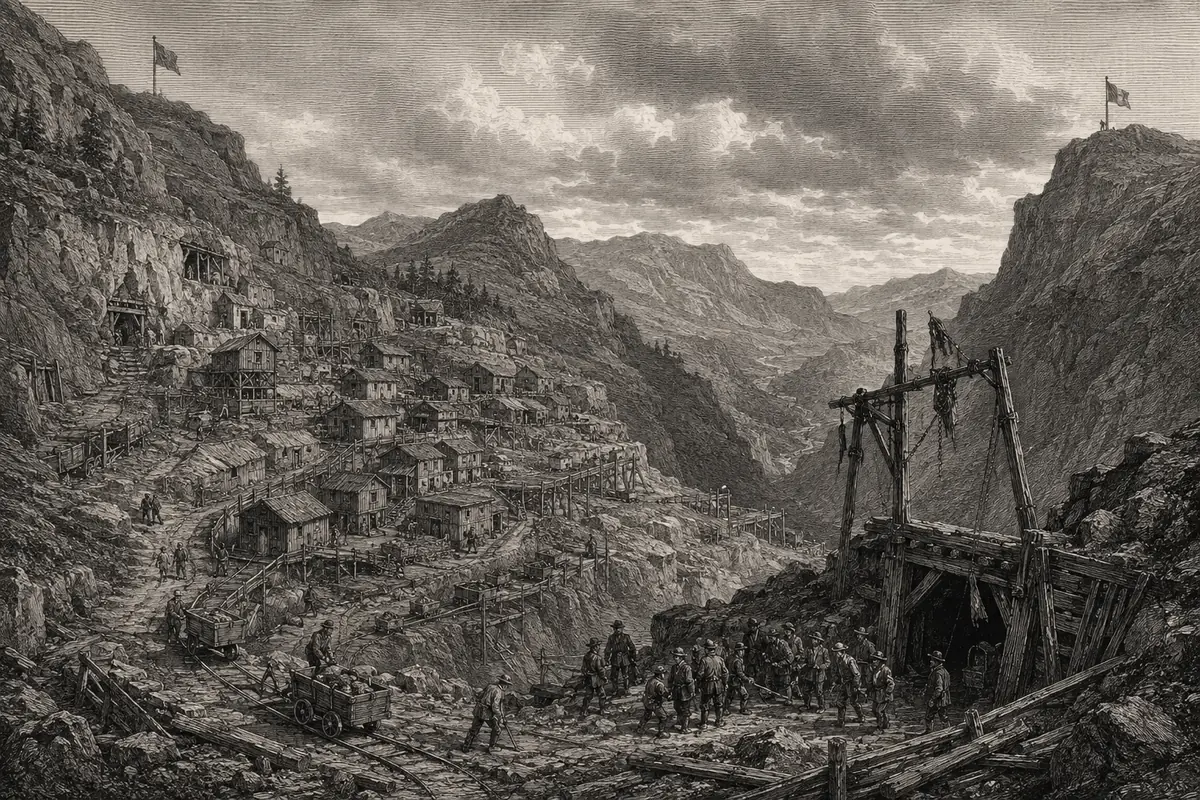
Derrin had three flags and one graveyard.
The company flag flew over the mine offices. The North Coast territorial banner marked the road checkpoint. Across the ravine, soldiers of Veyr had raised green and gold above a stone customs house abandoned before Theo was born.
The graveyard occupied the slope between them without a flag at all.
“Boundary follows the ravine,” said Captain Ors of the local troops.
“Old boundary,” corrected Deputy Seln, the mine company’s advocate. “The Charter lease recognizes the northern survey line.”
“Which places the North Pit partly in Veyr,” Mira said.
Seln smiled. “Maps are abstractions.”
Mira unrolled three of them on the hood of a supply wagon. “Then your miners are trapped in an abstraction.”
Theo had learned not to laugh when Mira meant to apply pressure. He turned it into a cough.
The North Pit entrance had collapsed twelve hours earlier. An overhead tram support failed, bringing stone and timber into the main incline. Thirty-two workers had entered on the night shift. Nine escaped. Four bodies had been recovered near the mouth. Nineteen remained below.
The company’s roster listed seventeen.
“Two seasonal haulers,” said a woman waiting beyond the cordon. “They pay them off book.”
Seln objected. Captain Ors told him to object farther from the families. Sabine ordered Theo to build the list from names.
Again, fear multiplied numbers. This time ownership did too. Company clerks omitted debt workers. Families included a cook who had left early. A foreman listed a man under his work name while his wife used the name he had been born with across the border.
By noon, Theo had nineteen.
The nineteenth was Lio Vass, fifteen years old on the family register and eighteen on the company roster. His mother pushed both papers under Theo’s hand.
“They add years so he can work nights,” she said. “Now they remove him because the number is inconvenient.”
Seln reached for the company sheet. “Seasonal ages are reported by household.”
“I am the household.”
Theo copied both ages and the discrepancy. “Which shift caller knows him?”
“Tomas Ren. My sister’s husband.”
The network of names began to take form. Tomas was married to the woman who had identified the off-book haulers. Lio worked ventilation with an older cousin. Two Veyr-born workers used North Coast names on payroll because border permits were renewed more easily when clerks did not pause over spelling.
The trapped nineteen were not a count distributed among flags. They ate at the same cookhouse, borrowed boots, covered one another’s debt shifts, and knew which foreman ignored cracking supports.
Nell established a family station beside the cordon. She did not call it comfort. She asked medical questions the people below could not answer for themselves: old lung illness, medicines, injuries, who panicked in darkness, who could translate for whom.
Thomas inspected the company rescue crew and rejected half their ropes.
“These passed quarterly review,” Seln protested.
Thomas bent one around his fist. The outer fibers split. “Then the quarter was too generous.”
He gave the foreman Guard line and made him demonstrate every knot. Nell watched Thomas dismiss two workers for exhaustion, then quietly moved one of them to the family station to carry water. Their decisions braided without discussion.
Mira and Sabine climbed the ravine to meet the Veyr officer beneath a white negotiation cloth. Theo saw Mira place all three maps on the ground, including the Veyr survey. She gave the opposing officer the dignity of arguing from his own line. Sabine secured six hours without armed advance in exchange for keeping Guard extraction south of the disputed crosscut.
The agreement lasted four.
Before entering the pit, Thomas required every Guard member to walk the evacuation route with eyes closed and one hand on the guide rope. The mine crews laughed until smoke cloth covered their own foreman’s eyes and he missed the second turn.
“Underground takes sight first,” Thomas said. “Then direction. Learn what remains.”
Theo followed the rope through the timbered approach. The world became touch, boot angle, air temperature, and sound. Nell’s medical pack clicked behind him. Mira dragged one toe at each junction to feel floor grade. Sabine kept a hand on Theo’s shoulder but no weight, a contact that said command remained present without steering his steps.
At the first turn, company machinery pulsed through the rail. At the second, he heard water dripping into a sump. Near the collapse, a faint irregular hammer came through stone before the signal crew had established contact.
“Someone is already striking,” he said.
The foreman removed his cloth. “Rock settles.”
“Rock doesn’t pause after four.”
The first living signal reached them before the surface equipment was ready because Theo had been made to enter without sight. Thomas did not say the exercise proved useful. He tied the guide rope at the exact place Theo indicated.
The pit approach exposed the company’s priorities. New iron rail ran toward the ore face. Ventilation pipe was patched with canvas. Emergency ladders ended one level above the deepest shift. A bright brass production counter survived beside a cracked support bearing three older repair marks.
Mira copied every detail.
Seln followed her. “The counter is required by lease.”
“So is safe ventilation.”
“The fan passed inspection.”
“When?”
“Six weeks.”
Nell held a lamp beneath the patch. The flame drew sideways through a seam. “It passed air somewhere.”
The foreman admitted the fan had changed pitch for three days. He had submitted a repair request. The company delayed shutdown until the current ore quota cleared.
Sabine sent the request number to the surface under seal. Seln tried to call it irrelevant to rescue. The families heard and began asking which official had set the quota.
The mine was not merely a dangerous place where border politics arrived. Its labor system had prepared the collapse, then used the border to complicate accountability.
Thomas and the mine crews cleared a path into the incline. Nell prepared for crush injuries and bad air. Mira compared ventilation shafts to surface survey marks. Sabine negotiated a rescue perimeter with Captain Ors and sent a formal notice across the ravine asking Veyr’s forces to keep distance.
They answered by moving twenty soldiers closer.
“They think the collapse opened a tunnel across the line,” Ors said.
“Did it?” Sabine asked.
Seln said, “Impossible.”
Mira looked at the maps. “Likely.”
Underground, the border had been excavated for better ore.
Theo found the miners through a rail.
The tram line vanished beneath the collapse, but its iron length continued into the pit. He set one end of his signal hammer against it and struck three times.
Silence traveled back.
He waited, then struck again.
Tap. Tap.
Someone below had heard.
The families behind the cordon surged forward. Sabine held up both hands. “Quiet. Every sound on the rail matters.”
Theo established the simple code from East Road, then built more. The miners had a shift caller who knew industrial bell patterns. They reported eleven people together beyond the second brace, three injured badly, air moving but weak. Another group of six was separated near the north ventilation raise. Two had gone toward an old crosscut and had not returned.
Nineteen.
All alive at the time of contact.
The woman who had named the off-book haulers pressed both fists to her mouth. “Can they hear us?”
“Through the rail,” Theo said.
“Tell Tomas I’m here.”
“We need to keep messages short.”
“That is short.”
Theo tapped the name in work-code letters. The reply came slowly.
HE KNOWS.
Tomas’s wife was named Iven. She became the family station’s interpreter for work code. When Theo shortened messages, she told families exactly what had been removed. When company clerks used payroll names, she supplied household names. The two Veyr-born workers were Aros and Den in company books, Arash and Dena to the people below.
“Which names do I tap?” Theo asked.
“The ones they answer to when frightened,” Iven said.
Lio’s mother, Sera, knew the ventilation crew’s meal rotation. From the untouched food tins, she calculated which shift section the boy had likely joined before the collapse. Her knowledge moved Mira’s estimate of the north group thirty yards closer to the old raise.
Company records had omitted Lio. His mother’s kitchen knowledge found him.
The woman laughed and cried at once.
For six hours, the rail became the only road no flag could close.
Theo learned the personalities in taps. Tomas answered in economical work code. Lio struck too softly at first, afraid of using air; Tomas made him take over so the boy would stay occupied. A woman named Perra had broken two fingers but continued moving loose rock with her other hand. The separated north group included a Veyr-born blasting engineer who knew the forbidden crosscut better than the company’s filed plan.
“Ask him whether the crosscut reaches the old customs foundation,” Mira said.
Theo sent the question.
The answer returned: YES. SEALED SURFACE. OPEN BELOW.
Captain Ors swore. Seln denied knowledge. The Veyr troops across the ravine began moving before anyone at the mine could have sent them the new information.
“Someone knew already,” Mira said.
Sabine looked at the company office, where a telegraph clerk was shutting a window. “Or someone told them.”
The collapse was becoming useful to people above it.
Theo sent extraction progress, air instructions, and questions about the collapse. The miners returned sounds they had heard before the fall: repeated cracks in the north supports, a foreman ordering production to continue, the ventilation fan changing pitch.
Mira marked every answer.
Seln watched from the company tent. “Statements made under distress are unreliable.”
“So are production reports made under profit,” Theo said.
Sabine heard. “Avelos.”
“I will record both.”
The company advocate left before he said something billable.
Near dusk, the trapped shift caller asked a question.
Before answering, Theo asked Sabine whether Unit Twelve had authority to remain through the night.
“Active rescue under Charter,” she said. “Unless border conditions trigger Regional Command.”
“Have they?”
“Not yet.”
“Then the answer is yes.”
“The answer is rescue is authorized now.”
Theo heard caution and mistook it for unwillingness to comfort. He did not yet understand that Sabine had seen the command messenger riding down from the west ridge.
GUARD STAY?
Theo looked toward Sabine. She stood at the ravine with Captain Ors, watching green-and-gold soldiers assemble near the old customs house. A messenger waited beside her with a sealed Regional Command case.
The rescue crews had opened twenty yards. At least sixty remained to the main pocket.
Theo could answer work continues. He could answer orders pending. Both were true.
Behind the cordon, families watched his hammer.
He remembered Evan asking what the wagon protected. He remembered the East Road child placing her next beat inside his.
Theo struck the rail.
GUARD WILL NOT LEAVE.
The answer returned at once.
HEARD.
Sabine’s shadow fell across the rail.
“What did you send?” she asked.
Theo told her.
She looked toward the sealed case in the messenger’s hand. “You do not have authority to bind Regional Command.”
“They asked whether the Guard would stay.”
“You could have said rescue continues.”
“That is not what they needed to know.”
“It is what you knew.”
Below, the miners began a work rhythm on the rail. They were moving loose stone from their side.
Theo said, “They needed a reason to save air and keep digging.”
“Then you tell them what is true enough to depend on.”
“I intend to make it true.”
Sabine’s face hardened. “That is the sentence I was afraid of.”
Across the ravine, a Veyr horn sounded. Captain Ors’s troops lifted their rifles from rest.
The messenger opened the Regional Command case.
“Lieutenant,” he said, “Veyr claims the north crosscut has breached its territory. Command orders you to prevent Guard personnel from entering any disputed workings pending negotiation.”
Mira looked at the pit map. The separated group of six waited beside the north ventilation raise.
Theo rested his hand on the rail.
His promise had traveled below before the order arrived.