
Bardo · The Oath
Chapter 3
Northbound
Field Unit Twelve travels inland toward Dunlow, where wet roads, contradictory witnesses, and a buried vibration challenge Theo's heroic expectations.
Field service began with a dispute over socks.
“Three pairs,” Thomas said.
Theo tightened the strap on his instrument case. “I have three.”
“You’re wearing one.”
“That is generally where I keep the first pair.”
Thomas pointed at Theo’s field pack. “Three dry pairs. Separate from the pair you surrender to the road.”
They stood beneath the dispatch arch at first light while rain polished the Command yard. Sabine had gone to sign the departure ledger. Nell was reorganizing the medical panniers on their mule. Mira crouched beside the north milestone, comparing it to a map that put the road six yards east of itself.
“How many socks are you carrying?” Theo asked.
“Enough.”
“A number revered by quartermasters.”
Thomas lifted Theo’s pack before Theo could object. “Light.”
“Efficient.”
“Light.” He opened the top flap and found the lute strings, two signal flags, spare tunic, writing case, oilskin, and the wrapped heel of Maren’s travel bread. “You brought an instrument and no second blanket.”
“The instrument earns its space.”
“Can it keep you warm?”
“Depends what I play and who owns the inn.”
Thomas gave him the pack. “Buy socks in Lower Ternwick.”
Theo had spent two years learning how not to abandon the position entrusted to him. Nothing in that discipline had prepared him for being ordered toward hosiery by a man one year older.
He bought the socks.
By noon, he understood the sacrifice.
The north road climbed through coastal farms in long, muddy grades. Rain entered at the neck, found the elbow, and appeared inside boots by methods that deserved formal inquiry. Unit Twelve traveled with two pack mules and no carriage. Sabine said roads could not be inspected from behind glass. Mira said roads could barely be inspected from the road, given the accuracy of Command maps.
Thomas set a pace that allowed conversation only when the hill did. Theo kept up for three hours before the lute case began pulling at his right shoulder.
Nell noticed first. “Switch sides.”
“I do.”
“Before your shoulder drops, not after.”
“Are all medical assessments delivered as accusations?”
“Only the free ones.”
At the next marker, Thomas took the case without asking.
Theo reached for it. “I can carry my own instrument.”
“Then carry my shield.”
The shield was broader, heavier, and less personally insulting. Theo accepted the exchange. Thomas adjusted the lute case high on his back, careful not to crush the neck.
“You know how to carry one,” Theo said.
“My mother plays.”
“Well?”
“She says so.”
The hill eased. Thomas lengthened his stride.
It was the first fact he had offered that did not concern equipment or failure. Theo stored it without pressing. Some doors opened away from the person waiting outside.
They spent the first night in a road lodge crowded with farmers driven in by the weather. The common room smelled of peat smoke, wet wool, and onions cooked past surrender. Sabine paid for floor space, then put the unit to work collecting accounts of the Dunlow floods.
Before the interviews, she made them establish a dry corner for records and a separate one for medical complaints. Thomas objected that there was no dry corner. Mira found a section of wall where the roof leak missed by three inches. Nell moved the complaint chair beneath the leak anyway.
“People describe pain more accurately when they know we are suffering too,” she said.
The lodge keeper watched them reorganize his room. “Guard usually takes the upstairs.”
“Upstairs is full,” Sabine said.
“I would clear it.”
“Of whom?”
He glanced toward two families sharing the narrow stair.
Sabine took the floor.
Theo noticed Thomas notice. Respect passed between them without speech; Thomas’s posture toward Sabine changed by the width of a breath.
Theo expected fear to sharpen facts. Instead it multiplied them.
A grain merchant said the lower channel had jumped its banks after every new moon. A carter swore the water rose only when the mills ran at night. An old woman with three geese tied beneath her table said there had been no true flood at all, only mill owners crying loss so they could petition for repairs.
“And the water mage?” Theo asked.
The geese objected to the phrase before she did.
“Evan Moss?” She tightened a rope around one chair leg. “Cleared reeds for my sister last spring. Wouldn’t take payment. Foolish in several directions.”
“Have you seen him alter the water?”
“I’ve seen men with papers alter more water than Evan ever touched.”
Across the room, Thomas interviewed the grain merchant. Mira had laid three maps on a bench and was asking drivers to mark where the road had washed out. Nell cleaned a child’s split heel while questioning his father about sickness after the flood.
Sabine moved between them without appearing to hurry. She listened more than she spoke. When two accounts conflicted, she did not select the speaker whose boots cost more.
Theo felt the old satisfaction of a pattern gathering. The Guard had arrived; frightened claims were becoming usable knowledge. Whatever Dunlow contained, they would separate it.
Then the lodge keeper brought out the room ledger.
“Hume’s men were here first,” he said quietly. “Three days ago. Asked who’d been talking about the channels.”
“Walter Hume?” Mira asked.
“His consortium owns the south mill and leases the north.”
Sabine joined them. “Did they threaten anyone?”
The keeper looked toward the grain merchant. “They reminded us the mills buy most of what comes off these farms.”
That was not a threat a magistrate could copy neatly. It was a fact positioned to do the work of one.
Sabine closed the ledger. “We record the visit. We do not assume it proves the flood claim.”
“Or nothing,” Theo said.
“Correct.”
The keeper’s shoulders lowered slightly. He had been braced for the Guard to either save him from Hume or call him a liar. Sabine had promised neither.
Theo helped Mira copy the road marks. Her maps were dense with small corrections: a culvert shifted, a bridge narrowed, an inn renamed after a marriage nobody at Command had recorded.
“Does any map survive you?” he asked.
“Good maps want to be corrected.”
“A generous philosophy from the person holding the pencil.”
She tapped the Dunlow sheet. “Three drivers put washouts here. Official channel runs here. Either the water climbed twelve feet uphill or someone changed the ground.”
“Hume.”
“You like conclusions before supper.”
“I like supper too.”
“Then keep one appetite from confusing the other.”
She drew another mark.
At the medical chair, Nell argued with a farmer who wanted medicine for his wife’s cough but refused to let her speak.
“She knows the cough better,” Nell said.
“She gets tired talking.”
“Then you can carry the tired after she gives me the facts.”
Thomas interviewed the wife while Nell listened, positioning his body so the husband could remain near without answering for her. Theo had assumed security meant standing between danger and a person. Thomas used it to create enough social space for a voice.
Later, when the room settled, Theo asked him where he learned that.
“My mother,” Thomas said.
“The musician?”
“Also a magistrate. Music is how she becomes unreasonable in private.”
“What does she play?”
“Badly, according to everyone who loves her.”
Nell, passing with bandages, said, “Kerr has now told you two family facts. At three, tradition requires betrothal.”
Thomas looked appalled. Theo nearly choked on lodge tea.
The joke did not make them friends. It made the wet floor briefly bearable, which was a more useful beginning.
The rain did not stop overnight. Theo slept beneath a table with his replacement socks inside his coat and Thomas’s shield against one shoulder. He woke twice to the scrape of quills. Sabine was still comparing witness accounts by the hearth.
Heroism, he discovered, had very poor sleeping habits.
On the third afternoon the land flattened into Dunlow’s outer marshes.
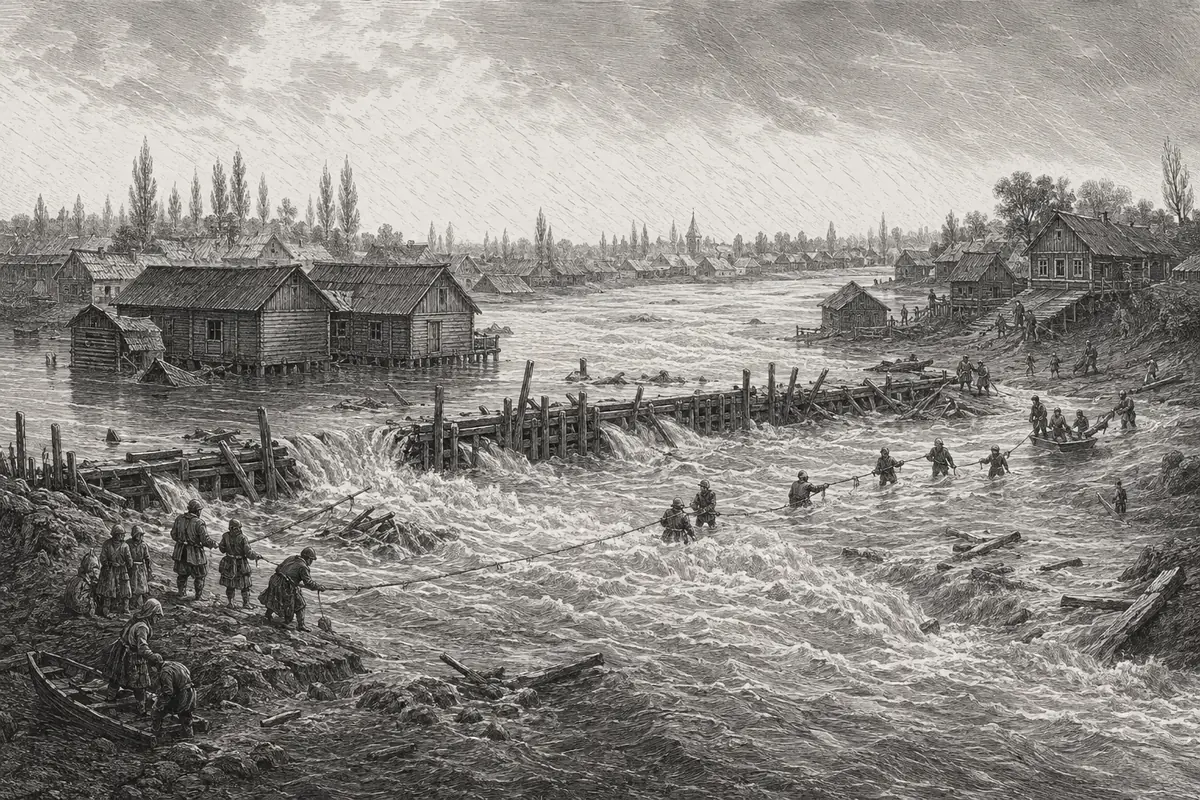
Water occupied every low place. Fields lay behind raised banks, their winter stubble dark beneath the rain. Narrow channels ran beside the road toward a line of mills whose wheelhouses leaned over the main race. Beyond them stood the old weir, a long gray back across the river.
At a distance it looked sound.
Closer, the road told another story. Fresh gravel filled washouts on the west shoulder. Reed roots hung exposed where current had cut the bank. A marker post stood in three feet of water with last year’s flood line painted well below the surface.
Local Warden Parn met them at the first bridge with four watchmen and a white Guard pennant already raised.
“Lieutenant Holt,” he called. “Glad to have authority here at last.”
Sabine dismounted from no horse, which made the welcome feel overdressed. “You have authority, Warden.”
“Not the kind people heed when a mage poisons the channels.”
Behind him, a crowd had gathered under dripping awnings. Some looked relieved. Others watched the white bridge arches on the unit’s collars as if counting locks on a door.
Parn offered a leather document tube. “Witness declarations. Damage estimates. Order for the arrest of Evan Moss.”
Sabine did not take the arrest order. “We inspect first.”
“He has been seen opening restricted gates.”
“Then the gates will have evidence.”
They walked toward the weir.
Thomas returned Theo’s lute case before they crossed the bridge. “Your instrument.”
“Your shield.”
Thomas tested the straps. “You carried left-heavy.”
“The road tilted.”
“For nine miles?”
“A regional defect.”
The bridge boards shuddered beneath a mill cart. Theo paused.
The movement did not stop when the wheels reached stone. A low tremor remained under the cart noise, too deep to hear cleanly but present in the soles of his boots. It strengthened, faded, then returned at an uneven interval.
Theo put one hand on the parapet.
“Avelos,” Sabine called.
He raised a finger, listening through his palm.
The stone carried water, wheel teeth, gate chains—and beneath them, a slow vibration like a paired string beaten out of tune by something too large to see.
“The weir,” Theo said.
Parn glanced upriver. “What about it?”
Theo counted the interval again. It did not match the mill wheels.
“Something is loading and releasing under the west side.”
The warden looked at Sabine. “Your musician has been here one minute.”
“Probationer,” Sabine said, “tell me what you observed. Not what it means.”
Theo removed his hand from the stone.
“A repeating vibration. Uneven. It remains when the bridge is clear and does not keep the wheel cadence.”
Mira knelt and set two fingertips against the wet parapet.
“I don’t hear it,” she said.
“You may not.”
“Can it be measured?” Sabine asked.
Theo looked toward the weir, where gray water pressed through the gates in orderly white lines.
“Give me a cord, three nails, and somewhere dry enough to tune.”
Nell looked up at the rain. “Ask for two miracles while you’re requisitioning.”
Sabine handed Theo the document tube. “Find the cord in stores. We begin at the west gate.”
The crowd followed them at a distance. The white pennant snapped above the bridge. Dunlow had its visible Guard control.
Underfoot, the old weir continued its patient warning.