
Bardo · The Oath
Chapter 7
The Arrest
As Dunlow counts its losses, Theo fights to preserve Evan's rescue in the official account before outside authority closes around the case.
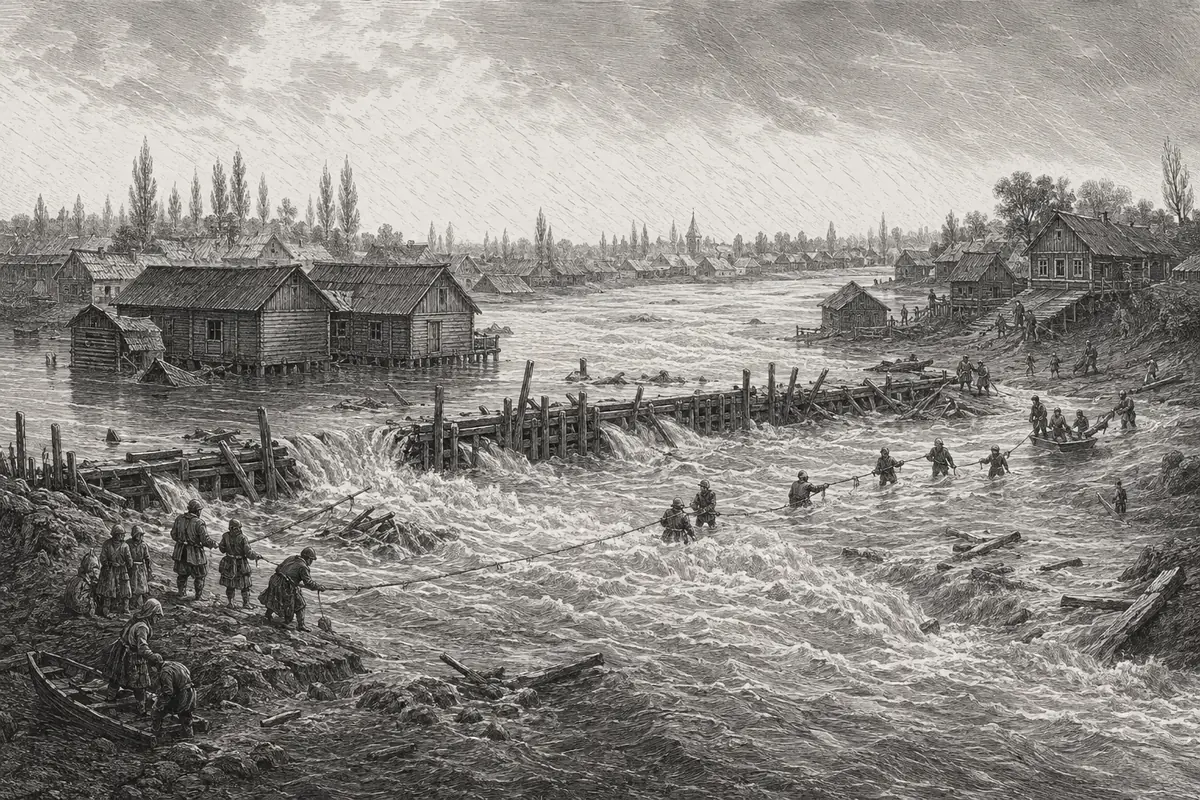
By morning, Walter Hume had turned a flood into a question of maintenance.
He did it at the long table in Dunlow’s council room, with dry cuffs, a physician’s note excusing him from the previous night’s labor, and three ledgers arranged before him. Behind his chair stood Arlo Venn, two company clerks, and an advocate from the district commercial court.
On the other side sat Sabine, Warden Parn, and Theo. Mira’s map covered the center of the table. Nell and Thomas were still at the cooper’s shop, because people had swallowed river water and roofs had not waited for hearings.
“Hume Holdings performed lawful improvements under the lease’s maintenance provision,” the advocate said. “The west culvert was cleared to prevent stagnation. The field channel was graded for worker access. No alteration required a district seal.”
Mira’s map showed the cut culvert, buried drainage bed, false channel, breached pasture, and route of the flood in five colors.
Theo put one finger beside the west line. “This moved water.”
“All maintenance moves water.”
“Into ground shown as closed on the diagram your company filed.”
“The diagram is illustrative.”
“It has measurements.”
“Illustrations may be measured.”
Theo looked at Sabine. “Am I permitted to dislike him in the record?”
“No,” she said.
The advocate’s expression suggested he was accustomed to being disliked more expensively.
Sabine opened Hume’s production ledger. “North Mill output increased sixteen percent after the culvert work.”
Hume folded his hands over his stomach. “Dunlow depends on that output.”
“Your night releases also increased.”
“Within our water allotment.”
“The allotment assumes the filed channel structure.”
The advocate leaned forward. “Lieutenant, we acknowledge an administrative discrepancy. We dispute causation. The flood occurred after an unregistered person repeatedly manipulated gates and water pressure.”
There it was. Hume’s work became paperwork. Evan’s became catastrophe.
Theo opened his witness folio. “Twenty-seven people saw Evan hold pressure away from the west gate. Six saw him redirect the current that trapped a Guard. Cora Bell states he opened night cuts to lower the buried drainage bed.”
“Cora Bell is a mill laborer, not an engineer.”
“She was enough of an expert when her first statement blamed him.”
The advocate glanced toward Hume.
Sabine said, “We will submit the infrastructure evidence to district review. Mr. Hume, your company will fund emergency grain replacement and immediate stabilization pending judgment.”
“Voluntarily?” Hume asked.
“Choose the word you can afford.”
For the first time, he looked directly at her.
Theo understood why the Guard was admired. Sabine could make a commercial lord answer a flooded cooper without shouting, because roads, districts, and courts recognized the same Charter. Hume had influence. The white bridge had reach.
Theo also understood that Evan was in a locked room downstairs.
They interviewed survivors until the lamp oil ran low.
Theo asked each person what they had seen before he told them what another person claimed. He separated water redirected by gates from water that appeared to turn without machinery. He recorded uncertainty. When the old woman from the lodge said Evan had saved two geese, Theo wrote it down, then crossed it out when she admitted the geese had been on the orchard road already.
“You have no respect for the central facts,” she told him.
“The geese survived.”
“Exactly.”
Cora arrived after dark with her sister. They sat side by side, hands joined beneath the table.
“Venn told us the night cuts caused the floods,” Cora said. “He said Evan wanted the mills closed because Hume dismissed him.”
“Was Evan employed there?” Theo asked.
“Gate crew. Three years.”
“Why was he dismissed?”
Cora’s sister answered. “He refused the culvert work.”
Theo set down his pen. “Who can confirm that?”
“Half the crew.”
“Will they?”
The sisters looked at each other.
Cost again.
Theo said, “The Guard can take statements without names in the public record. The district court may still require identities later.”
“And Hume can still close the mill,” Cora said.
“Yes.”
He wanted to promise the Guard would prevent retaliation. He remembered Derrin only as a name he did not yet know; he remembered the Selection field as a cost he did.
“I can promise to record the risk,” he said. “Lieutenant Holt can request worker protection. I cannot promise what the district will grant.”
Cora studied him. “You’re new.”
“Painfully visible?”
“The older ones lie more smoothly.”
Her sister squeezed her hand. Cora gave the statement.
When Theo finished, Sabine read every page. She made him replace concealed work with unfiled work until intention could be proved. She also made him add Evan’s exhaustion after each redirection and the fact that he had saved Thomas.
“Why include the exhaustion?” Theo asked.
“Because ability reports that omit limits become fear documents.”
“Have you written many?”
“Three.”
“What happened to the people?”
Sabine turned a page. “One was released after fraud was established. One died during the event. One went to assessment.”
“After assessment?”
“I don’t know.”
The same honest edge as in the marsh.
Before the formal statement closed, Nell sent word that Evan was alert enough to speak. Sabine took Theo downstairs.
The custody room had one barred window, a cot, and a table fixed to the floor. Evan sat with his bandaged foot raised on a folded blanket. His wrists were free, though an iron ring had been locked around one ankle. Thomas stood outside the door rather than inside it.
“Medical interview only,” Nell said. “Ten minutes. If he loses the thread, you stop pulling.”
Theo placed the witness pages on the table. “Hume’s production increase is in the record. Cora confirmed the culvert work and your dismissal.”
Evan looked at Sabine. “And the mage?”
“Ability use is recorded separately from flood cause,” she said.
“Separate pages travel in the same wagon.”
Theo sat. “Tell us what you can do in terms that cannot be inflated later.”
“They can inflate silence.”
“Then make them work harder.”
Evan rubbed both hands over his face. “I feel pressure in connected water. Not every drop. A channel, pipe, saturated ground—places force has somewhere to travel. I can lean on the route. Hold it open. Make one pressure spend itself against another.”
“Can you create water?”
“No.”
“Raise it without source?”
“No.”
“Stop a river?”
He laughed once. “A river would stop me.”
Theo wrote each limit.
“What does it cost?” Nell asked.
“Headache. Shaking. Sometimes I lose where the ground is.”
Thomas, outside the door, shifted his weight. He had seen Evan unable to stand.
Sabine said, “Why did you not report the ability before the channel dispute?”
“To whom?”
“A district physician. Guard assessment.”
“My uncle reported his. They said he needed individual review.”
“What happened?” Theo asked.
“No forwarding address.”
The phrase was not yet familiar. It still had the power to sound administrative rather than final.
“How long ago?” Sabine asked.
“Nine years. My aunt writes every Midwinter.”
Nell’s ten minutes ended. Evan leaned toward Theo before they stood.
“You want the report to save me,” he said.
“I want it to tell the truth.”
“The truth is I moved water without their gates. They can cut every other fact away and keep that.”
“Then we make the other facts impossible to cut.”
Evan looked toward the high barred window. “That is what I used to think channels were for.”
In the corridor, Thomas waited until the door shut.
“Put the limits in the main finding,” he said.
Sabine regarded him. “Security recommendation?”
“Yes. Fear fills empty capability. If the public reads only water mage, they imagine a river that obeys him.”
Theo added Thomas’s recommendation beneath Nell’s medical limits. Evan’s account now existed in four hands, not one.
Upstairs, Cora and six mill workers had gathered in the council hall. Walter Hume’s advocate had offered continued employment if they signed a joint statement declaring the west work ordinary maintenance. None had signed. None could afford to remain dismissed.
Sabine used emergency authority to place them on paid stabilization crews for ten days while district labor review opened. It did not secure their futures. It made retaliation visible and bought them time.
“Is that protection?” Cora asked Theo as he copied the order.
“Some.”
“How much?”
“Ten days.”
“Then write ten days.”
He did. She signed her full statement.
Before Theo could ask more, bootsteps crossed the hall.
The man who entered wore no field branch color beneath his Guard coat. A narrow black-glass pin fastened his collar beside the white bridge. He was in his forties, clean-shaven, with rain on his boots and none on his shoulders.
“Examiner Owen Marr,” he said. “Office of Special Inquiry.”
Sabine rose. “We were not notified of transfer.”
Marr placed a sealed authorization on the table. “Then you are notified.”
Theo looked at the seal. Central issue, rank unreadable beneath wax.
“Our report is not complete,” he said.
Marr glanced at the probationer’s arch on Theo’s collar. “The report is not custody.”
“Custody changes the report. We have not taken Evan’s formal statement.”
“Assessment will take what is necessary.”
Sabine read the authorization twice. When she looked up, she had already found the limit of her authority.
“He is medically unstable,” she said.
“A transport physician is outside.”
“Nell Arden is the treating medic.”
“She may submit notes.”
Theo heard the pattern: everything they offered became paper. Paper did not delay the wagon.
“He saved at least thirty people,” Theo said.
Marr removed one glove finger by finger. “Then your report should be persuasive.”
“Will the assessment consider it?”
“Individual assessment considers all relevant facts.”
“Where is he going?”
Marr looked at him fully now. His eyes were pale and incurious.
“To assessment.”
Below, a door opened.
Theo reached for the unfinished pages. Sabine put a hand over them.
“Finish,” she said quietly.
“They’re taking him.”
“Finish the work only you can do.”
The words returned him to his chair.
Through the council-room window, Theo watched Marr’s people bring Evan into the square. Nell walked beside him arguing with the transport physician. Thomas followed as far as the wagon. Evan’s hands were cuffed in front. His left boot had been replaced by a bandaged foot and an oversized Guard shoe.
He looked up at the window.
Theo could not know whether Evan saw him through rain and glass. He raised the report anyway.
The wagon left before the ink dried.