
Bardo · The Oath
Chapter 7
Candidate Year
After passing Selection on his second attempt, Theo spends a year learning the law, limits, habits, and machinery behind the Guard uniform.
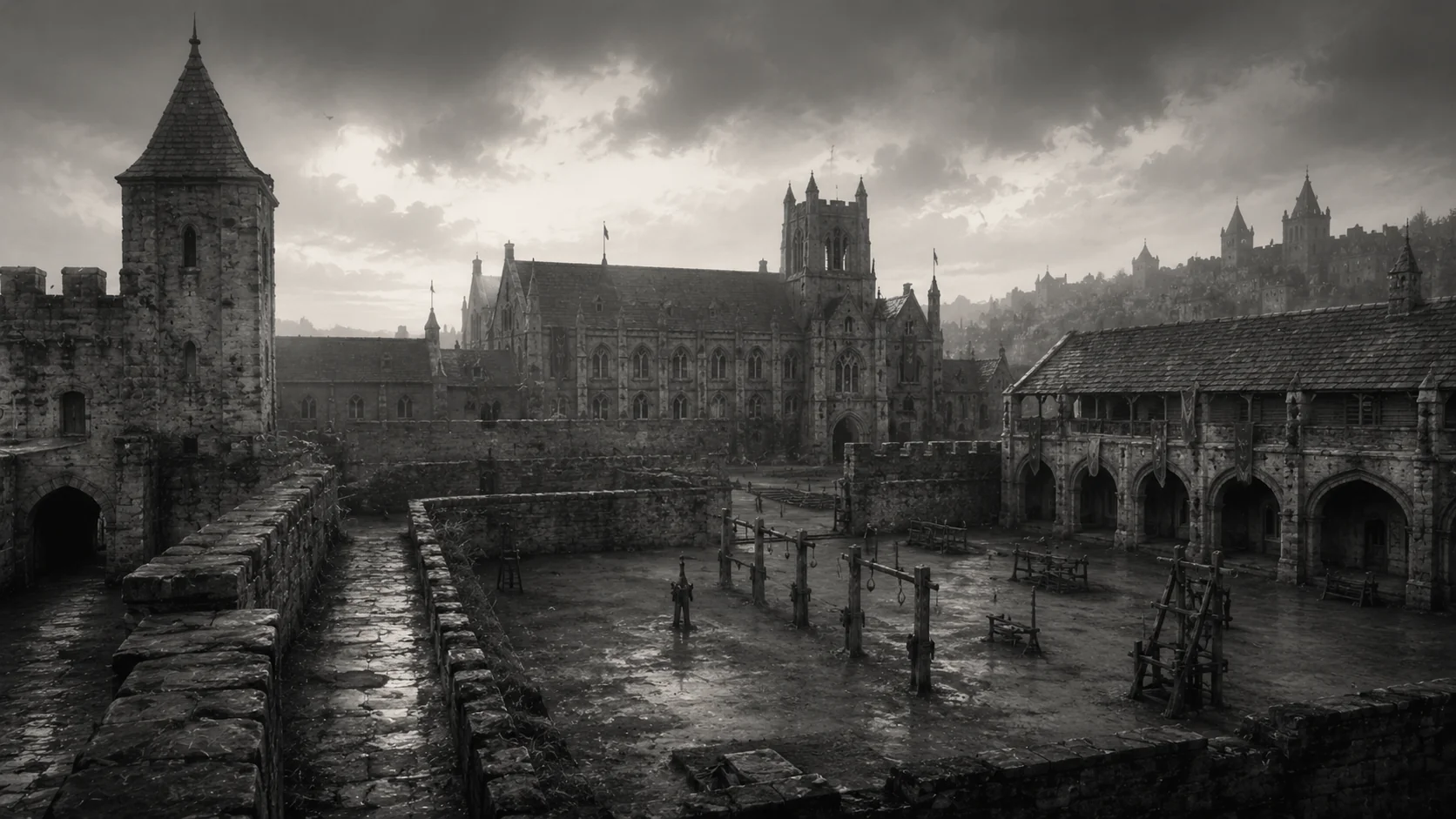
Theo passed Selection the second time without rescuing anyone who had not asked him to.
This disappointed him slightly.
The Group Crisis Assessment gave him a collapsed bridge, two false casualty reports, a blocked western route, one candidate who panicked halfway through a signal sequence, and no dramatic stranger pinned beneath anything. Theo remained at communications until relieved, rerouted the west team, sent a medic instead of himself when a runner reported chest pain, and finished with his baton still in his hand.
Chief Assessor Vale read the result from a slate.
“Pass.”
Theo waited.
Vale looked up. “There is no second word.”
“I know.”
“You appear to be expecting one.”
Theo thought of Joanna’s good intentions matter only when discipline makes them reliable and decided not to request praise from a man holding forty assessment files.
“Thank you, sir.”
Vale’s mouth moved by a fraction.
“You may discover Candidate Year contains several words.”
It did.
Most were legal.
Candidate Year began with Theo placing both hands on a plate of black glass.
He had seen the material before in Guard stations: dark, reflective, usually set into Examiner cases or screening tables and handled with the care people gave either expensive instruments or poisonous things.
The plate in North Coast Command’s intake room was circular and thick as a paving stone. Silver lines had been set around its edge in measured intervals. A technician cleaned it between candidates with alcohol that smelled aggressively medicinal.
Theo stood in shirtsleeves while a records officer checked his file.
“Theodoros Avelos.”
“Theo.”
“Registered name for screening.”
“Then the glass may have all four syllables.”
The officer did not smile.
Across the room, Pell did.
Theo had not spoken to him properly since the failed Selection two years earlier.
Pell wore candidate gray with a green Medical Support tab pinned at one shoulder. He had become broader and cut his hair shorter. He also looked exactly like the person Theo still remembered holding two signal flags because Theo had left him a half-finished route.
That was inconvenient.
The technician said, “Hands flat.”
Theo obeyed.
The glass was cold.
A low tone sounded from a brass resonator beneath the table.
Then a second.
Theo felt vibration through his wrists.
The technician adjusted a lever. A pulse moved through the plate, too weak to hurt and strong enough that the tendons in Theo’s fingers noticed.
Nothing happened.
He had known nothing would.
Everyone knew what screening was for.
Active manifestations could produce branching silver condensation, sudden temperature change, surface clouding, ringing, or other measurable disturbances in treated black glass. The exact response varied. The public version was simpler: mages made the glass react.
Theo had heard stories as a child about candidates who cracked plates by touching them.
Maud had called those stories proof that children should not be trusted with technical vocabulary.
The glass beneath Theo’s hands remained dark and still.
“Clear,” the technician said.
The records officer stamped his file.
Theo lifted his hands.
Relief surprised him.
Not because he had suspected anything.
Because a person could apparently be relieved by the confirmation of something he had never doubted.
Pell took his place next.
Theo waited by the door.
Pell’s glass remained clear too.
When they were released into the corridor, Theo said, “I owe you an apology.”
Pell kept walking.
“For the screening?”
“For the first Selection.”
“That was two years ago.”
“Yes.”
“I had noticed time passing.”
Theo almost smiled, then decided Pell had earned the right to be difficult.
“I left you without the east route.”
“You did.”
“I’ve been sorry since.”
Pell stopped beside a window overlooking the training yard.
Theo expected anger.
Pell looked tired instead.
“I failed that assessment too,” he said.
Theo blinked. “Because of me.”
“Partly.”
Pell leaned against the stone sill.
“You signaled me to take the east station. I took it. Then I stood there waiting for you to finish the route instead of sending a runner to confirm it. I had options.”
“The assessor said—”
“The assessor was explaining your failure to you. He explained mine to me later.”
Theo said nothing.
For two years he had preserved Pell in memory as a person he had made carry his mistake.
That had been true.
It had not made Pell passive.
“I shouldn’t have left,” Theo said.
“No.”
“You still had choices.”
“Yes.”
Theo considered this.
Pell looked at him. “Are you going to apologize for apologizing incorrectly?”
“I was considering revisions.”
“Don’t.”
They continued toward intake lecture.
Pell became one of the people Theo ate with twice a week and never quite became close friends with. This also surprised him. At nineteen, Theo had imagined relationships as things that resolved if everyone spoke honestly enough.
At twenty, he was beginning to understand that some became better without becoming simple.
The Guard taught law before weapons.
Theo had expected the reverse.
For six weeks Candidate Year was mostly classrooms, ink, route cases, medical drills, and instructors explaining the many ways a well-intentioned Guard could accidentally create an international dispute.
The Common Charter occupied three hundred and twelve pages in the candidate edition.
Theo disliked page eighty-four on principle.
Page eighty-four contained the beginning of interregional custody authority, a concept written in sentences long enough to require rest stops.
Instructor Edwin Hale taught Charter Law with a cane he did not need and a habit of calling on candidates immediately after they looked confident.
“Avelos,” he said one morning. “A district captain orders a probationer to close a bridge. A physician says closure will prevent a medical convoy from crossing. Who controls?”
Theo had learned to distrust questions with only two nouns.
“Why is the bridge being closed?”
Hale nodded once. “Flood damage.”
“Is the convoy already on the bridge?”
“No.”
“Alternate crossing?”
“Four hours south.”
“Patient condition?”
“Unknown.”
“Then I don’t know.”
Several candidates looked at him.
At the beginning of the year, Theo would have felt the need to improve the answer.
Hale said, “Good.”
Theo frowned.
“The Charter does not reward certainty produced by missing facts,” Hale continued. “The captain controls the bridge. The physician controls the medical assessment. Neither expertise becomes total because the problem has only one road.”
He wrote three words on the slate.
AUTHORITY. EXPERTISE. RESPONSIBILITY.
“They overlap,” he said. “They are not synonyms.”
Theo copied the words.
They would prove more useful than page eighty-four.
Field medicine taught him that competence had borders.
Nell Arden would later insult his splinting with more efficiency, but Candidate Instructor Sora Venn established the foundation.
Theo’s first forearm splint was too tight.
His second was too loose.
His third secured the wrist beautifully and trapped the patient’s thumb in a position no human being would choose voluntarily.
The patient was Pell.
“You play an instrument?” Pell asked while Theo unwound the bandage.
“Yes.”
“With these hands?”
“I am usually kinder to myself.”
Venn stood over them.
“What did you check after tying?”
“Stability.”
“And?”
Theo looked at Pell’s fingers.
Color.
Temperature.
Sensation.
He had checked none.
“Circulation.”
“After you built the splint?”
“No.”
“Then you built a fine device for creating a second injury.”
Theo took it apart.
He learned to ask where something hurt before touching it.
He learned that a person saying I’m fine did not close a medical question.
He learned how much blood looked like too much and how often people survived it anyway.
He learned that the body was neither metaphor nor argument.
It had limits whether courage approved of them or not.
Physical training corrected other assumptions.
Theo was fit.
He had spent years hauling Relief Fund crates, walking Ternwick’s hills, and practicing breath because music punished lazy lungs.
The Guard considered this a pleasant beginning.
Candidates ran roads in field packs. Climbed wet walls. Carried stretchers with shifting weights. Learned how quickly strong legs became ordinary after six hours.
Theo was not the fastest.
He was nowhere near the strongest.
His balance was good. His recovery was better than average. His hands remained steady when tired longer than most Signals candidates because Maud had spent fourteen years punishing tension.
He liked discovering where he was genuinely good.
He liked less discovering where other people were better.
Candidate Jori San could run uphill at a pace Theo considered personally insulting. Pell could carry a medical pack and one end of a stretcher without losing speech. A quiet Transit candidate named Daran could judge wagon clearance by looking once at a wheel track.
Theo began asking how they did things.
This improved him faster than wanting to beat them.
He still wanted to beat them sometimes.
Growth, Maud would have said, was not sainthood.
Signals and Dispatch was the first branch that felt immediately like a language Theo had been speaking badly for years.
Acoustic codes were only part of it.
Candidates learned flag systems, relay timing, messenger priority, damaged-line improvisation, map grids, custody seals, weather notation, and the discipline of writing down the message they actually received instead of the one that made more sense.
That last rule caused arguments.
“If a runner says north bridge and every other fact indicates south,” Theo said, “you clarify.”
“Yes,” said Senior Guard Hessa Ro.
“And if you cannot?”
“You record north.”
“Even if it’s wrong?”
“You record what arrived, mark the contradiction, and prevent your correction from becoming invisible.”
Theo thought of Tessa preserving the misspelled name on a Relief Fund form.
“Because otherwise nobody knows where the error entered.”
Ro looked at him. “Exactly.”
Theo wrote the rule in the margin.
Correction without trace creates a new uncertainty.
He liked Signals more after that.
Music trained him to hear relationships.
Dispatch trained him to preserve them.
The oath was taught late.
Theo had known the words since he was twelve.
Most Ternwick children knew at least the first line. We stand between appeared on Guard memorials, recruitment posters, relief stores, and cheap commemorative cups sold during Charter anniversaries.
Candidate Year made them parse each clause as law.
I stand between danger and the unguarded.
Not I defeat danger.
I will answer the call.
Not every call belonged to the person who heard it first.
Keep the road.
Road meant literal routes and protected access: bridges, medical passage, evacuation lines, lawful transit.
Speak true in my record.
A field record carried legal weight beyond memory.
Place no rank above the lives entrusted to me.
A superior could issue lawful orders. Rank did not convert an unlawful sacrifice into duty.
Theo loved the oath more after learning its technical meaning.
That should perhaps have worried him.
Instead it felt like finding the structure beneath a piece of music he already loved.
The words were not decoration.
They had engineering.
By winter, Candidate Year stopped feeling like preparation and began feeling like work performed without final authority.
Theo accompanied supervised patrols. Logged road closures. Helped run a shelter during a cold snap. Spent three days at a supply depot discovering that blankets could vanish administratively without anyone stealing them if three offices used different bundle sizes.
He returned to Avelos House whenever schedules allowed.
The family changed less dramatically than he did, which meant he noticed the changes late.
Corin now worked full days beside Alden and argued with him about harbor modernization in voices too similar for either to enjoy.
Tessa had begun legal apprenticeship under Maren and could cite registry procedure at supper until Bram threatened to charge her rent by subsection.
Maren asked Theo fewer questions about whether he ate enough and more about whether Candidate rules allowed him to refuse unsafe orders.
Alden wanted details about Charter jurisdiction.
Maud wanted scales.
“I’m studying field law,” Theo protested one evening.
“Does law require your fourth finger to become lazy?”
“No.”
“Then civilization survives another hour.”
He practiced.
The old fourth peg had begun to stick in damp weather.
Maud told him to oil it.
Theo forgot.
Field Selection came in the last month.
Candidates did not choose a unit.
They submitted preferences, instructors submitted evaluations, branch officers reviewed vacancies, and some administrative intelligence nobody understood attempted to prevent seven people who all hated mornings from being assigned together.
Theo requested Signals and Dispatch, field rotation, North Coast or neighboring region.
He also wrote travel preferred and immediately worried it made him sound unserious.
Pell requested Medical Support.
When assignments were posted, candidates crowded the board.
Theo stayed at the back for six seconds to prove he had discipline.
Then pushed forward.
AVELOS, THEODOROS — SIGNALS & DISPATCH — NORTH COAST DETACHMENT — FIELD UNIT TWELVE — PROBATIONER PENDING OATH
Theo read it twice.
Field unit.
Travel.
Signals.
The thing he had wanted since Lantern Quay had become a line on a board.
Pell appeared beside him.
“Medical Support,” Pell said. “Reserve route, eastern relay.”
Theo looked over.
Pell’s assignment placed him in a different company at North Coast Command.
Theo raised two fingers, the old signal between them.
Then completed the route designation properly.
Pell smiled.
“Learned something.”
“Several expensive things.”
They shook hands.
The uniform arrived folded.
Theo carried it home in a plain brown issue box because candidates were forbidden to wear Guard blue before the oath.
Tessa met him at the front door.
“Is that it?”
“No. Kitchen supplies.”
She took the box from him.
“The kitchen has never looked this smug.”
Corin came down the stairs. Maren appeared from the east parlor. Alden from his office. Bram from nowhere in particular, which remained one of his skills.
Theo put the box on the dining table.
Inside lay the charcoal-blue coat, gray trousers, weather mantle, branch cord, and an empty place where the white bridge badge would be fastened after the oath.
Theo touched the coat.
The cloth was heavier than ceremonial uniforms looked from a distance.
Tessa lifted one sleeve.
“You cannot wear it.”
“I know.”
“You were reaching.”
“I was examining.”
“You had your arm positioned for examination.”
She folded the sleeve back.
“Tomorrow.”
Theo looked around the table.
At six, Theodoros had belonged to paperwork and Theo to the family.
At nine, a Guard captain had used Theo’s name after carrying Tessa through smoke.
At sixteen, Joanna had told him one useful night did not make a character reference.
At nineteen, the Guard had rejected him.
At twenty, it had accepted him on the second attempt and spent a year teaching him how much he still did not know.
Tomorrow the presiding commander would ask for his registered name.
For once, Theo thought, Theodoros might have a job worth doing.
He closed the box.
“Don’t let me wear it early,” he told Tessa.
She sat on the lid.
“I have been preparing for this responsibility my entire life.”