
Bardo · The Oath
Chapter 6
Winter Signals
After failing Selection, Theo spends a winter learning service without glory through wet ledgers, stubborn evacuees, and the discipline of staying at his post.
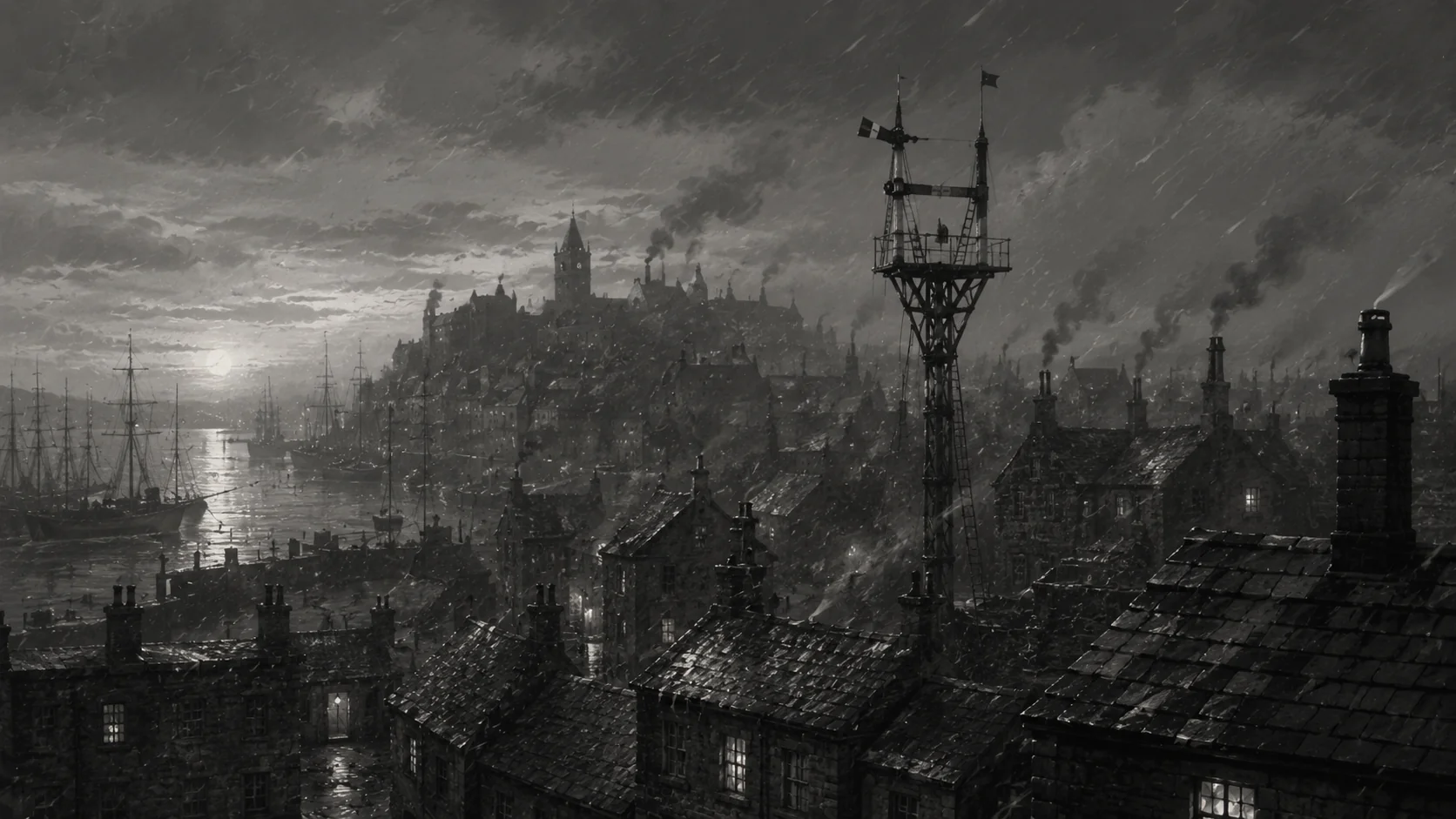
The Ternwick Relief Corps gave Theo a red wool armband and a desk that leaked.
He had expected worse from the armband.
The desk offended him personally.
Rain entered through a crack above the signal-room window, followed the stonework down, and landed every twenty-three seconds on the upper-left corner of the dispatch ledger. Theo moved the ledger. The drop changed course.
He moved it again.
The drop struck the ink pot.
“Do not negotiate with the building,” said Vera Dey from the next desk. “It has more winter than you do.”
Theo looked at the ceiling. “The building started it.”
Vera was fifty, broad through the shoulders, and had worked winter relief since before Theo was born. Her official title was shift coordinator. Everybody called her Dey because the Corps had once employed three Veras and bureaucracy had surrendered.
She slid a cracked pottery saucer beneath the leak.
“Now it has a destination.”
Theo considered the solution.
“I was trying to stop the water.”
“Yes. That is why you have been here six weeks and I have been here twenty-three years.”
Outside, the storm bell sounded one long note from the western tower.
High tide warning.
Theo straightened.
The signal room occupied the second floor of a converted customs shed near the lower harbor. From its windows he could see almost nothing useful in hard weather: rooflines, gray water between buildings, the tops of signal posts. The room mattered because everything else connected to it.
Speaking tubes ran to the harbor watch and three relief depots. Brass wire bells linked the western flood gate, the north shelter, and Avelos House. Runners came and went with written reports in oilskin cases. A wall map showed low streets in blue pencil and evacuation routes in red.
Theo had spent most of his first week wishing he were on one of those routes.
By the sixth, he had learned to distrust the wish.
Dey checked the tide board.
“South quay families?”
Theo opened the ledger. “Twenty-one notified. Fourteen confirmed moving. Three already at kin addresses. Four refusing.”
“Reasons?”
“Two say the last warning was unnecessary. One won’t leave a pregnant goat.”
“A compelling civic argument.”
“The fourth is Joren Vale on Copper Lane. Says somebody broke into his rooms during the autumn evacuation and the Corps reimbursed only the door.”
“Was he robbed?”
Theo had checked.
“Yes.”
“Then write that, not refusing.”
He looked down at the column.
The form offered EVACUATED, DECLINED, UNCONFIRMED.
“There isn’t a box for declined because our last procedure failed him.”
Dey held out her hand.
Theo gave her the pencil.
She drew a line beneath the boxes and wrote the sentence anyway.
“Forms are cheaper than people,” she said. “Make the form suffer.”
Theo smiled.
He liked Dey.
This was inconvenient because she was almost always telling him no.
A runner arrived soaked through.
“West gate says water over the lower step. Watch requests two more bodies for Copper Lane.”
Theo stood.
Dey did not look up. “Sit.”
“I know Copper Lane.”
“So do six runners.”
“Vale won’t move for a stranger.”
“He does not know you.”
“My family fund handled his claim.”
“That is not the same as knowing you.”
Theo sat slowly.
The failed Selection lived under moments like this.
Not as humiliation anymore. As a very irritating second voice.
You are nearest had once sounded like enough reason to move.
Dey pointed at the speaking tube.
“What can you do from here?”
Theo considered.
“Find out what he needs.”
“Good.”
He called the south depot.
The depot sent a runner to Copper Lane with a message rather than an order: What would make you leave?
The reply returned twenty minutes later.
Seal on rooms. Written inventory. Watch witness.
Theo read it twice.
“He doesn’t want persuasion,” he said.
“No.”
“He wants us not to fail the same way twice.”
Dey glanced over. “People are exhausting that way.”
Theo sent the request to the harbor watch.
The watch complained about manpower.
He sent back the flood-depth report and the old theft claim number.
The watch agreed to seal the rooms if the Relief Corps supplied an inventory witness.
Theo assigned a runner from the north shelter who had trained as a warehouse clerk.
Joren Vale evacuated with one trunk and no argument.
Theo wrote EVACUATED in the box and added the conditions beneath it.
The success felt good.
It also felt nothing like crawling under a beam.
No smoke. No blood. No one looking at him as if he had arrived at the exact right moment.
A pencil, three messages, an old complaint somebody had kept, and another person doing the walking.
Useful work had a disappointing lack of posture.
The storm deepened after dark.
Wind drove seawater over the outer quay and up two drainage streets. The Corps opened the north schoolhouse as a shelter. Avelos House took twelve people when the schoolhouse cots filled, including the pregnant goat after Maren refused to debate species policy during a flood.
Theo remained at the signal desk.
His lute was wrapped in oilskin beneath it.
Dey had laughed when he brought the instrument his first shift.
“You expect requests?”
“Signals carry better on strings than voice in some rooms.”
“You expect rooms?”
“I expect to be prepared.”
“That’s how hoarding begins.”
She let him keep it.
At nine that evening, the north speaking tube failed.
Water had entered a junction box beneath the market road. The bell wire still worked, but the north shelter could send only preset patterns.
Dey looked at the map.
“We need head count every half hour.”
“Runner route?” Theo asked.
“Market road is knee-deep at the low crossing.”
Theo took out the lute.
Dey stared at him.
“You have been waiting six weeks for this.”
“Longer.”
The shelter bell line shared a wall bracket with an old acoustic pipe once used by the customs office. It no longer carried speech clearly, but Theo had tested it during a quiet shift because quiet shifts made him inventive and dangerous to furniture.
He set the lute against the pipe housing and played a low paired interval.
The metal hummed.
Again, harder.
A faint answer returned through the wall.
Dey stopped smiling.
“What can it carry?”
“Simple pulse patterns. Maybe more if they have something resonant at the other end.”
“They have a school bell.”
“Excellent. Education saves us again.”
Theo sent the Corps count request as a modified harbor code.
Three short. One long. Repeat.
The answer came as dull bell strikes through the pipe.
Forty-seven sheltered.
Two medical complaints.
No missing names.
Theo wrote it down.
For the next two hours, the old pipe carried counts, requests for blankets, one medicine code, and an increasingly personal complaint about the schoolhouse stove.
Dey listened to the third stove message.
“Tell them heat is not a dispatch category.”
Theo played the acknowledgment anyway.
At ten-thirty, a runner burst through the door.
“Roof down on Ropewalk Four.”
Theo’s hands stopped above the strings.
“How many?” Dey asked.
“Unknown. Neighbors heard a child. Watch crew can’t reach from east street.”
Theo knew Ropewalk Four.
A row of narrow houses behind the cordage sheds. The western lane stayed higher in floods. From the signal room, he could reach it in four minutes if he ran.
He was already calculating before he noticed.
Four minutes.
Maybe three.
He knew the route.
He knew how to brace a simple collapse from Relief Fund drills.
He knew what a child sounded like when adults had not reached them yet.
Dey said, “Theo.”
He looked at her.
“Your hands.”
He realized he had begun wrapping the lute.
The room narrowed.
“There’s a child.”
“Yes.”
“I can get there faster than a north crew.”
“Yes.”
The agreement made leaving harder.
Dey pointed to the map.
“West watch is two streets away but doesn’t know the lane is open. North shelter has a carpenter with its rescue team. The harbor wagon is carrying braces but is routing east because nobody updated the crossing.”
Theo looked at the three communication lines.
“What do you need?” she asked.
Not what do you want to do.
Theo put the lute back against the pipe.
He sent the north shelter a rescue priority call and the Ropewalk address.
He rang west watch with the high-route code.
He sent a runner downstairs to turn the harbor wagon at Dock Street before it reached the flooded crossing.
Then he waited.
Waiting was physical.
His legs wanted motion. His mind kept inventing reasons why the signals might fail and why his body would solve the problem better.
Dey did not tell him to calm down.
She made him keep the ledger.
“West watch?”
“Received.”
“North team?”
“Moving.”
“Wagon?”
“Runner not back.”
“Send another by second route.”
Theo did.
The child remained a fact on paper for seven minutes.
Then the west bell sounded.
CONTACT MADE.
Theo exhaled.
Four minutes later:
ONE CHILD. ONE ADULT. BOTH ALIVE. STRUCTURE UNSTABLE.
The carpenter reached them before the brace wagon.
The wagon arrived three minutes after that.
At eleven-twelve, the final message came.
BOTH REMOVED. MEDICAL TRANSFER.
Theo stared at the words.
Dey took the pencil from his hand.
“You can shake now.”
He was.
He sat back.
“I could have been there.”
“Yes.”
“I might have helped.”
“Yes.”
Theo looked at her, irritated by the refusal to make the lesson simple.
“But?”
“No but.” Dey wrote the time beside the message. “You might have helped there. You helped here. The question is which work could be replaced.”
Theo looked around the signal room.
The leaking desk. The bell wires. The old pipe. The map with six moving problems and one person responsible for keeping them connected.
“If I left,” he said, “you would still be here.”
“I would.”
“So I was replaceable.”
Dey smiled slightly. “Good. Now count what I was already doing.”
Medical requests.
Shelter capacity.
Watch routing.
Flood depths.
Supply wagons.
The answer changed.
Theo rubbed his face.
“This work is designed to make people feel less important.”
“Only people who confuse importance with being irreplaceable.”
He disliked that enough to remember it.
The storm ended two days later.
Ternwick woke wet, tired, and largely intact.
The Relief Corps spent the next week on work nobody painted.
They counted spoiled grain.
They dried cots.
They found temporary rooms for three families whose houses remained unsafe.
They argued with a merchant who donated blankets and then tried to invoice the city for transport.
Theo carried water, copied claims, reset bell wires, and played signal patterns until one upper string broke from cold.
The child from Ropewalk Four was named Pera. She was eight. Theo learned this from a medical return slip, not from meeting her.
Her father had a broken wrist.
The report credited west watch, the north carpenter crew, the harbor brace wagon, and dispatch coordination.
Theo’s name appeared once in the attached signal log.
He read it.
Then felt foolish for having looked.
Of course he had looked.
Recognition mattered to him. The winter did not cure that. It merely made the desire easier to see when nobody supplied it.
He folded the report and returned it.
At home, Tessa had taken over one end of the dining table with schoolwork and Relief Fund claim copies.
Corin was home late from harbor duty. Alden had lost an argument with a shipping syndicate and was explaining at length why this proved the syndicate irrational. Maren was asleep in an armchair with a ledger open on her lap.
Theo entered carrying the red Corps armband, damp boots, and the lute with its broken string.
Tessa looked up.
“Hero returns.”
“I spent today inventorying mold.”
“How brave was it?”
“Green in the center. White at the edges.”
She nodded gravely. “Advanced mold.”
Theo sat opposite her.
“What are those?”
“Storm claims.”
“You are fourteen.”
“I can alphabetize at fourteen.”
“That seems unsafe.”
She held up a page.
“Joren Vale. Door seal witnessed, room inventory attached, no loss reported.”
Theo took the form.
The note he had written during the storm had traveled through watch paperwork, Relief Fund review, and back to Tessa’s table.
The chain of it pleased him more than seeing his name in the signal log had.
“Keep that one,” he said.
“I was going to.”
“Of course.”
He restrung the lute while she worked.
In spring, Theo submitted his second Charter Guard application.
The form asked why he believed he was suited to service.
At nineteen he would have written about courage, signals, negotiation, and Lantern Quay.
He still believed in all four.
This time he added logistics, record discipline, flood routing, and twelve months of Relief Corps work.
Then he stopped before the final line.
The question beneath it read:
Describe a decision you would now make differently.
Theo thought of Lysa beneath the awning.
He thought of Ropewalk Four and the four minutes his body had wanted to claim.
He wrote:
I would ask which responsibility can be replaced before deciding that the nearest suffering is mine to answer personally.
He read the sentence twice.
It was not a promise that he would always succeed.
That made it the first answer on the application he trusted.