
Bardo · The Oath
Chapter 9
East Road
A storm buries travelers beneath the East Road, giving Unit Twelve a crisis with no conspiracy and no enemy except stone, weather, and time.
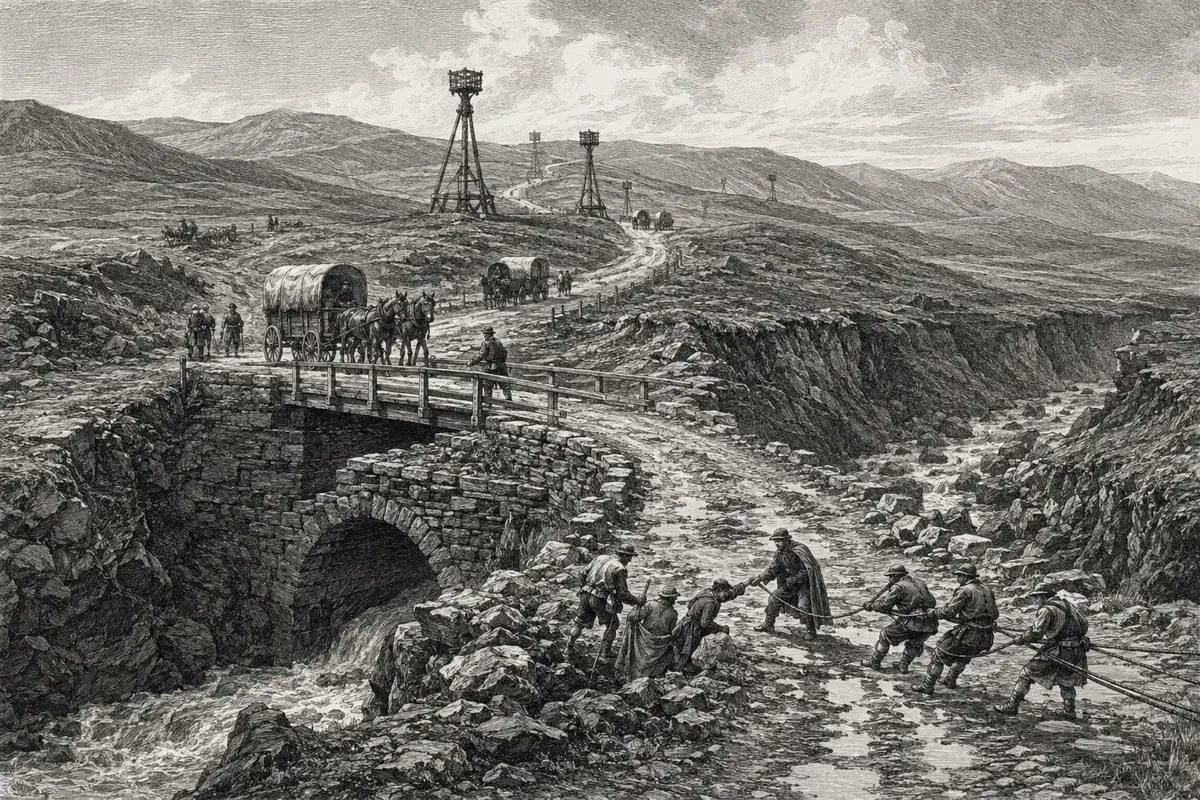
The East Road fell at half past four in the afternoon.
Unit Twelve was beneath it.
They had left Ternwick before dawn carrying the unanswered destination request for Evan Moss in Sabine’s dispatch case and orders to inspect storm damage along the pass. Rain had softened the retaining wall for three days. The road wardens had closed the upper lane but kept the lower open for mail, food wagons, and travelers unwilling to lose a week to weather.
Theo heard the wall fail as a succession of small decisions.
Pebbles ticking against the wagon roof. A timber brace cracking above the wheel noise. Thomas saying, “Out,” before the driver understood. Then the deep granular roar of a hillside discovering motion.
Theo jumped from the wagon. Sabine dragged the driver after him. Mira cleared the ditch in two strides. Nell seized the medical pannier instead of her own pack. Thomas cut the lead mule free.
Stone struck the road behind them.
The wagon rolled onto its side. Mud, blocks, and broken wall buried the track from cliff to drop. Dust turned the rain white.
For several seconds there was only settling rock.
Then people began shouting from the far side.
Sabine counted the unit by name. Each answered. Nell had a cut along one cheek. The driver had injured his wrist. One mule had vanished beneath the slide; the other stood shaking in the ditch with Thomas’s hand over its eyes.
Mira climbed the unburied end of the wall and looked east. “Two passenger carts, one farm wagon, people on foot. Some cleared. Some did not.”
“Secondary movement?” Sabine asked.
Mira watched the slope. Rain traced new lines through the raw earth. “Certain. Timing unknown.”
Sabine assigned the field.
Thomas stabilized the surviving wall with the road crew. Nell established triage beneath the cliff overhang. Mira found safe approach lines. Theo took signals, survivor count, and communication across the blocked road.
He did not move toward the nearest cry.
He climbed the broken wagon, raised his red flag, and waited until the road warden on the far side answered.
The first count said eleven missing.
The second said fourteen.
A farmer insisted his daughter had been walking beside the passenger cart. The cart driver swore she had climbed into the farm wagon before the pass. Two brothers each believed the other had gone back for their mother. A traveling cook counted a hired boy whom nobody else remembered seeing that day.
Road Warden Kes had kept the lower lane open. He said so before anyone accused him.
“Mail wagon carried fever medicine,” he told Sabine. “Close the whole pass and South Vale loses two days.”
“What warning did the wall give?” Mira asked.
“Runoff through the upper seam. Same as every hard rain.”
“Pebble fall?”
Kes looked toward the broken wagon. “Morning. Stopped by noon.”
“Brace movement?” Thomas asked.
The warden hesitated.
One of his workers answered. “Third post shifted. We reset it.”
“Recorded?”
“No time.”
Kes closed his eyes. The decision had not been corruption. Medicine had been real. So had merchant pressure, familiarity with lesser warnings, and the desire to avoid closing the pass again after two false alarms.
Sabine assigned him to survivor counts instead of removing him from the rescue.
“You need me?” he asked.
“You know who passed the checkpoint.”
“Afterward?”
“Afterward you answer for the lane.”
Accountability waited without making his current knowledge useless. Theo watched Kes go to the families and say, “I kept it open.” He did not add the medicine first.
Theo built the list from names rather than numbers.
“Tell me the last place you touched them,” he said. “Not where you think they went.”
He marked each answer on Mira’s quick map. The farmer had tied his daughter’s scarf beneath the cart canopy. One brother had handed the mother a walking stick at the lower milestone. The cook had given the hired boy a copper to fetch water before the pass.
Facts located bodies. Fear moved them everywhere.
By dusk the list held twelve missing with confidence and two uncertain.
There was no Hume consortium. No Examiner wagon. No person whose secret act explained the hill. The retaining wall had been built in three periods, repaired badly in two, and loaded by rain. The road warden had closed half the pass and believed half was enough.
That simplicity did not make the stone lighter.
Thomas and the road crew opened a narrow trench from the west. Mira found a second approach above the slide but declared it unsafe for more than one person. Nell treated three crush injuries and sent one messenger back toward the nearest village for carts, lamps, blankets, and every shovel not attached to a farmer.
Theo established a signal line through the blockage. Metal stakes driven into the road carried hammer taps better than voices. One strike meant stop. Two meant pull. Three meant silence and listen.
At full dark, somebody beneath the stone answered.
Tap. Tap. Tap.
The entire road went still.
Theo knelt with one ear near the stake.
Three taps again. A pause. Then two.
“More than one person,” he said. “They have space enough to strike.”
Nell crouched beside him. “Can you ask how many?”
Theo chose a pattern simple enough to teach through stone: one tap for yes, two for no. He struck three times to request silence, then asked with counted blows whether four or more were together.
One.
Yes.
Five or more?
One.
Six?
Two.
“Five,” he said.
The farmer began crying. Not because his daughter was certainly among them, but because five had become people again.
Sabine looked at the slope, the crews, the rain. “Night operation.”
The road warden exhaled. “Lieutenant, the upper bank may come down.”
“It may.”
“You could lose rescuers.”
“We use Mira’s limits. We rotate. We stop on her call, not mine.” Sabine turned to Theo. “Keep them answering. Do not promise when we reach them.”
He heard the instruction beneath the words. Dunlow had taught them all something.
Theo struck the stake.
We hear you, he told the buried people in the smallest language available. Work has begun.
Their answer traveled through wet stone into his hand.
By midnight, the rescue had become a village.
The farmer whose daughter was trapped began interfering with the trench. Twice he carried stone after Thomas told him to stop. The third time, Thomas took him by both shoulders and moved him behind the signal line.
“You would dig for mine,” the farmer said.
“Yes.”
“Then let me.”
Thomas looked at the unstable slab, then at Theo’s message crews. “Carry tap reports from Avelos to the east team. If you miss one, they may cut your daughter’s air.”
The farmer accepted because the task mattered, not because it soothed him. His first report arrived too fast and incomplete. Theo sent him back for the exact pattern. By the third, he had become the most reliable runner on the road.
His fear did not diminish. It acquired work.
Farmers held oilskins over the trench. The traveling cook fed crews from a pot balanced on fallen masonry. A priest kept names and lamp oil. Two girls carried messages because they could cross the crowded road without anyone noticing enough to stop them.
Unit Twelve made the labor cohere.
Thomas knew how to remove a block without letting the load choose a new bearer. Nell set rotation limits and threatened to sedate anyone who called exhaustion courage. Mira listened to the hillside with her knees in the mud, ordering thirty people back when a harmless-looking trickle changed color. Sabine negotiated every conflict between speed and safety without pretending there was a clean answer.
Theo kept the buried group present.
One of them knew hammer code from quarry work. Through patient questions, Theo learned they were in the hollow beside an overturned cart. One person had a leg trapped. A child was cold but conscious. Air entered somewhere on the east side.
“Tell the child to sing,” the farmer said beside Theo.
“Why?”
“She sings when frightened.”
“What song?”
He named a harvest round Theo knew from Relief Corps kitchens. Theo tapped its count. After a pause, a faint metal rhythm answered—not melody, but the beat.
The farmer covered his mouth.
Theo did not say she would live. He kept the beat steady enough for her to place the next one inside it.
Near dawn, three new taps came from farther south.
Not the cart hollow. Another survivor.
Theo marked the place. A man on the west crew shouted that he had heard a voice beneath a visible slab twenty yards away.
“Help me,” the voice called. “Please, I’m here.”
It was close enough to understand every word.
Sabine’s plan kept Theo at the stakes, coordinating two trapped groups and the teams approaching them. The visible slab needed hands. Theo had hands.
He stood.
Thomas saw. Across the trench, he shook his head once.
Not an order. A reminder.
Theo sat again and sent the nearest free crew to the voice. Because he remained at the signal line, he heard the southern taps weaken. He redirected the upper team before they cut across the only air path.
The visible man was freed twelve minutes later.
The five beneath the cart kept answering.
When the rain finally thinned, the hillside was still dangerous, the road remained broken, and nobody had been saved by revelation. They had been saved so far by people performing assigned work while fear offered simpler tasks.
Then the child beneath the cart stopped tapping.