
Bardo · The Oath
Chapter 10
Under Stone
With a child silent beneath the collapse, Theo must trust the rescue plan he once would have abandoned and make discipline serve compassion.
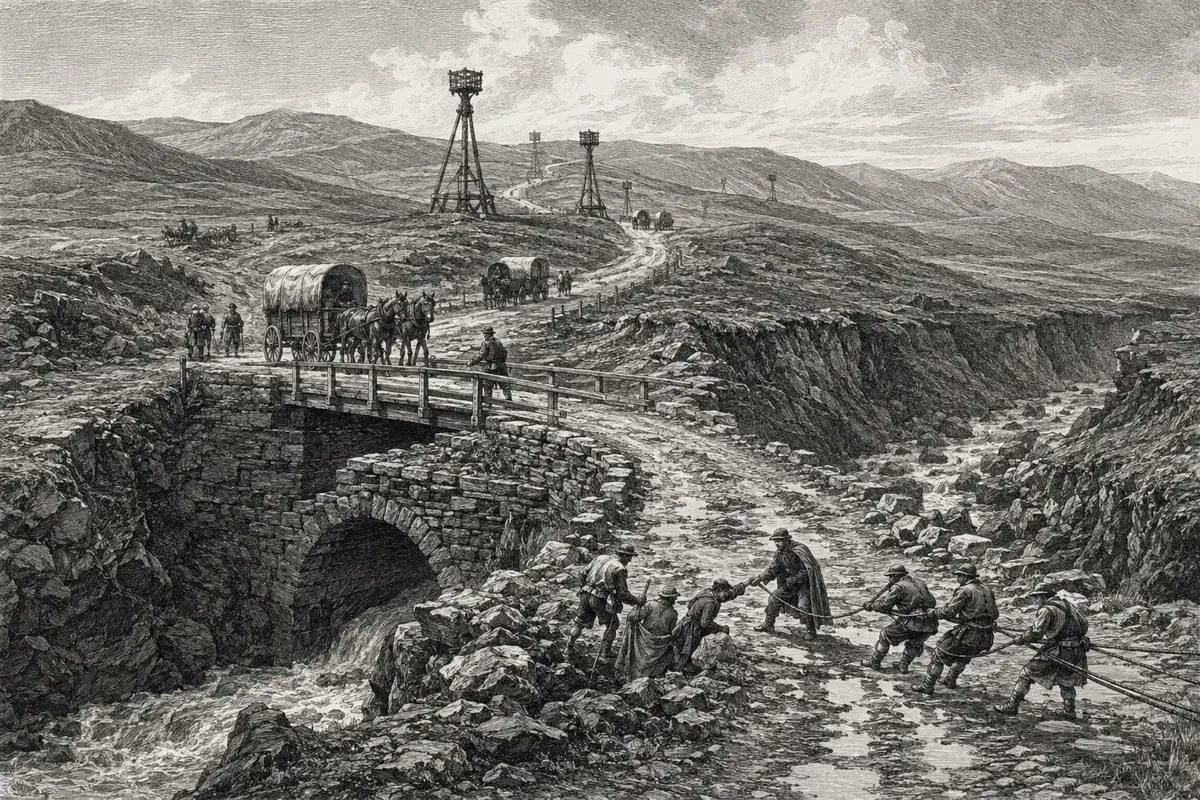
Silence beneath stone was not proof of death.
Nell said it once. Theo repeated it to the farmer. Then he returned to the signal stake and asked questions nobody answered.
Was the child conscious?
Two taps had meant no. There were no taps.
Was anyone able to reach her?
No taps.
Was the air path blocked?
Nothing.
Thomas lay on his stomach at the end of the west trench, one arm inside a gap between blocks. “I can feel the cart wheel.”
Mira marked the angle. “Hollow is six feet east and three down.”
“We remove this slab,” a road worker said.
“Remove it and the upper course drops,” Thomas replied.
The worker slapped mud from his gloves. “Then brace it.”
“With what?”
The surviving wagon had provided two axles, four side rails, and every sound board Theo had not protected quickly enough. The road crew had brought timber, but much of it now held the first trench open.
Theo looked at the signal grid. The southern survivor had resumed tapping. The visible man was out. Teams could be recombined.
He took a wax tablet to Sabine.
“Move the south brace crew here,” he said. “Leave one listener. Thomas gets two rails. Mira’s upper approach can carry a line to lift, not people.”
Sabine studied the sketch. “Who coordinates the remaining taps?”
“I do, from the junction.”
“Can you hear both?”
“With separate pitches.”
He replaced one iron stake with a thinner road spike. The buried groups answered in different metal voices.
Sabine nodded. “Do it.”
It was not obedience alone. It was Theo using his position to change the plan without abandoning it.
He sent the signals.
The cart hollow opened by inches.
Thomas and the crew braced the upper slab with wagon rails. Mira took the lift line above, lying flat on safe ground while six farmers hauled from behind the crest. Nell waited at the trench mouth with blankets, splints, and the expression she wore when the world had become an argument with the body.
Theo kept one hand on each signal stake.
The quarryman beneath the cart began answering again. Four adults alive. One trapped by the leg. The child unresponsive. Water entering slowly.
“Air?” Theo tapped.
One. Yes.
“Can touch child?”
One.
“Breathing?”
A long pause.
One.
The farmer beside Theo folded in half with relief, then straightened because work remained.
Nell sent instructions through taps too complex for the first code. Theo converted them into counted groups. Put the child between bodies. Cover her head. Do not force drink. Keep her airway clear. The quarryman repeated each pattern before acting.
At the south pocket, the lone survivor began striking too quickly.
Panic had its own tempo. Theo answered with a slow two-beat count and received no agreement. He tried again. The strikes accelerated.
“Air or water?” Sabine asked.
“Can’t tell.”
“Send a crew?”
He looked at the cart trench. Removing anyone now would slow the opening. The southern pocket had one person. The cart held five, including a child.
This was the field Joanna had meant: not a visible victim and invisible numbers, but two people made visible through the same responsibility.
Theo changed the question.
“Can hear digging?” he tapped south.
One. Yes.
“Toward you?”
One.
The east crew, working from the other side of the slide, was closer than Unit Twelve’s map showed. Theo signaled them through the upper relay and received confirmation.
“East crew reaches him,” he told Sabine. “Keep everyone here.”
She did not praise the judgment. She used it.
The upper slab lifted.
Thomas crawled into the gap first. Mud swallowed his boots. The brace groaned against the shifted load.
“One at a time,” he called.
The first trapped traveler emerged with a broken arm tied to his chest. Then a woman with blood crusted over one ear. The quarryman refused to come until the others were clear.
The third adult dragged himself out using both elbows. “The child,” he said. “She’s blue.”
Nell went in.
Sabine caught her pack as the gap narrowed around it. “Time?”
“Three minutes before cold becomes the least of it.”
Theo did not know which part of the body she meant. He kept the lift rhythm steady.
The quarryman came out carrying the farmer’s daughter. She was eight, perhaps nine, wrapped in a torn coat. Her face had the pale waxed look of a candle before lighting.
The farmer made one sound and stopped because Nell shouted, “Space.”
She knelt in mud, opened the child’s airway, and began breathing for her. The road narrowed to Nell’s hands and counted compressions.
Theo heard the count. He wanted to join it. He wanted to make the rhythm hold her because rhythm was what he could offer when the world became larger than his strength.
His signal stake rang.
The southern survivor.
Theo turned away from the child and answered.
The east crew had broken through. One long strike meant free.
He relayed it to Sabine. She sent two medics east without pulling Nell from the child.
Behind him, the farmer whispered his daughter’s name: Elia.
Nell continued.
Water dripped from the broken wall in an irregular measure. Thomas held the cart trench open for the last trapped adult. Mira called changes from above. Sabine moved people where each could alter the outcome.
Elia coughed.
It was a small, harsh sound. The farmer dropped to his knees.
Nell rolled the child and cleared water from her mouth. “Blanket. Warm, not hot. She goes first cart.”
The whole road exhaled, then returned to work.
Elia’s extraction did not end her danger. Nell needed warm transport, oxygen-rich air, and a route down a road blocked in both directions. The nearest clinic lay west; the open approach lay east.
Mira proposed lowering the farm cart by rope down the orchard terrace to a service track. Thomas said the axle would not hold the angle. Kes, the road warden, knew a drainage ramp hidden beneath thorn scrub. He had built it for maintenance and omitted it from the public map because merchants used service roads to evade tolls.
“You have a habit of protecting roads by making them unavailable,” Mira said.
“Today you can use it.”
They cleared the ramp. Thomas reinforced the cart with the last unbroken wagon rail. The farmer chose to travel with Elia’s mother rather than stay at the trench, transferring his runner role to one of the two girls.
The rescue network changed shape without collapsing. Theo updated every signal point. The child left the pass alive because medical skill, a concealed road, Thomas’s load judgment, and a father’s willingness to stop watching the hole worked together.
The last trapped adult was the quarryman.
His leg lay beneath the cart axle and a shelf of stone. He had kept the others tapping while blood filled his boot.
Thomas could not free the axle without lowering the upper slab. Lowering it would close the rescue gap.
“Cut the cart,” Mira said from above.
“Load transfers to his leg,” Thomas called.
Nell crawled in far enough to examine him. “If we pull without control, he loses it above the knee. If the shelf shifts, he loses more.”
The quarryman said, “I’m attached to the leg.”
His voice was weak but indignant.
“For now,” Nell said.
Theo lay at the trench mouth. He could hear the man’s breath and the faint scrape of stone whenever Thomas moved.
“What’s your name?” Theo asked.
“Bran.”
“Bran, do you know quarry lift songs?”
“I know better songs.”
“We have a limited audience.”
Theo tapped a slow four-count on the brace. Bran answered on the cart frame.
Thomas looked back. “What are you doing?”
“Giving you a shared count. Mira lifts on one. You unload the axle on two. Nell pulls the leg on three. Brace settles on four.”
“If the shelf moves between?”
“Bran can hear it first.”
The quarryman struck the frame once: agreement.
They rehearsed without force. On the third count Bran swore at Nell, which she accepted as evidence of attention.
Then they did it.
The upper line tightened. Thomas levered the axle. Nell pulled. Stone grated in the dark.
Bran broke the rhythm with three frantic strikes.
Theo shouted stop.
Everyone froze.
A section of shelf settled where Nell’s shoulder would have been.
They reset the lever two inches east.
On the second attempt, Bran came free with his leg intact below a crushed shin. Thomas carried him out as the trench closed behind them.
No cheer followed. People were too tired, and the road still held dead they had not reached.
Sabine stood beside Theo while dawn opened pale over the pass.
“You stayed at the line,” she said.
“I wanted to go in.”
“I know.”
“Elia might have died while I answered the south pocket.”
“The man in the south pocket might have died while everyone watched Nell save Elia.”
Theo looked at the two signal stakes, thick and thin, each carrying a different life through the same ground.
“Does this become easier?”
“No,” Sabine said. “You become less interested in ease.”
Below them, Nell ordered him to carry blankets. Thomas asked for water. Mira needed the final survivor count.
Theo went where the work required him.